
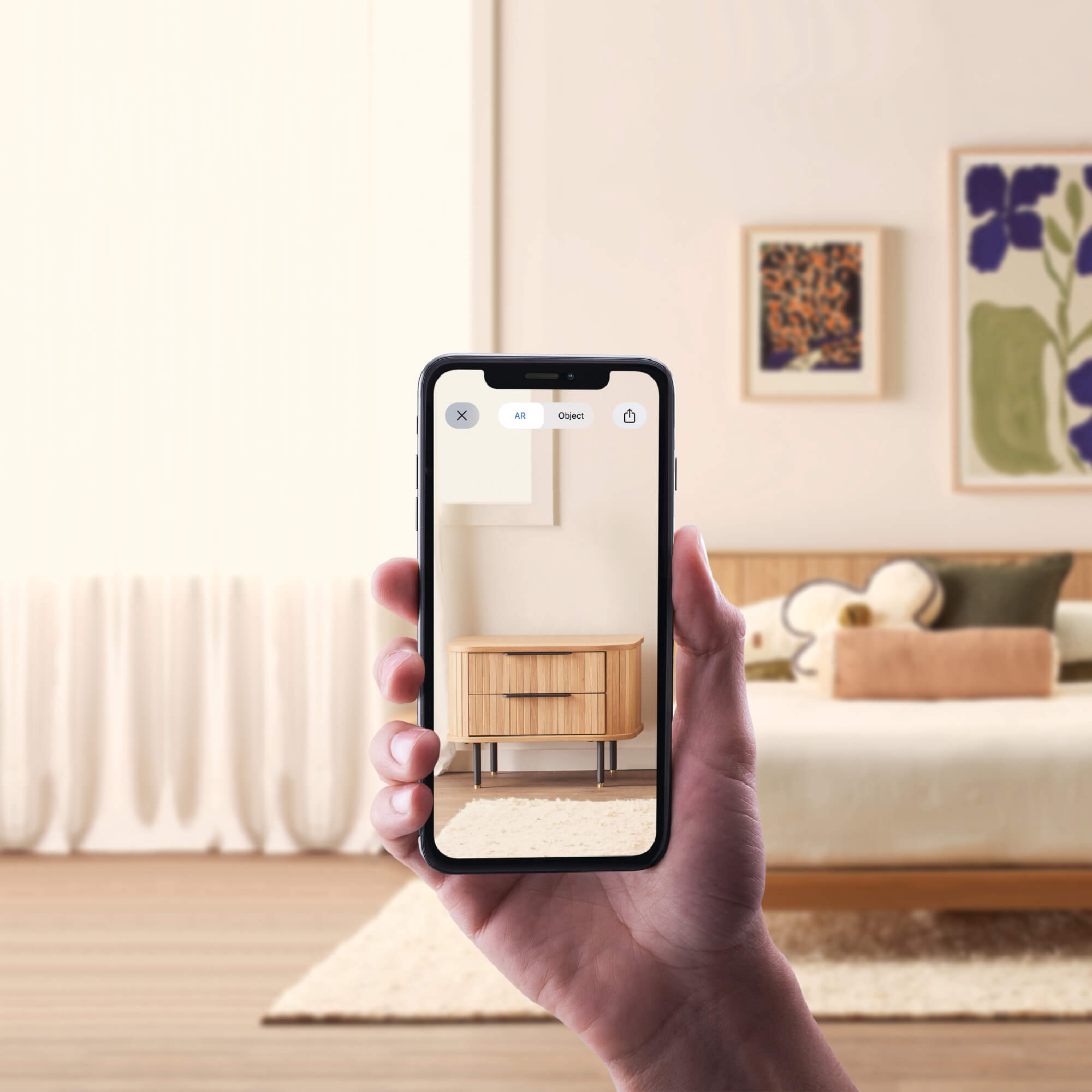

Retail has always been about experience. From storefront displays to in-store demos, brands have constantly looked for ways to help customers feel confident about what they’re buying. Today, that experience is increasingly digital, and augmented reality (AR) is playing a major role in reshaping how consumers interact with products.
AR allows shoppers to visualize products in real-world contexts before making a purchase. Whether it’s seeing how a sofa fits in a living room or trying on makeup virtually, AR bridges the gap between online convenience and in-store confidence. As customer expectations rise and competition intensifies, retailers are turning to AR to create more engaging, personalized, and frictionless shopping journeys.
In this post, we’ll explore how augmented reality enhances the retail experience, where it delivers the most value, real-world use cases, implementation challenges, and practical steps retailers can take to adopt AR effectively.
What augmented reality means for modern retail
Augmented reality overlays digital elements, such as 3D models, animations, or information, onto a user’s physical environment using smartphones, tablets, or smart displays. Unlike virtual reality, AR doesn’t remove users from the real world. Instead, it enhances what’s already there.
In retail, this capability directly addresses a long-standing challenge: helping customers make informed decisions without physically interacting with products. AR provides context, scale, and realism that static images or videos can’t fully deliver.
At a high level, AR in retail enables:
- Better product visualization
- Interactive and personalized shopping experiences
- Reduced uncertainty during purchase decisions
- Stronger emotional connection with products
These benefits translate into measurable business outcomes, from higher conversion rates to improved customer satisfaction.
Key ways AR enhances the retail experience
1. Improving product visualization and confidence
One of the biggest barriers in online shopping is uncertainty. Customers often ask, Will this fit? Will it look good? Will it match my space or style?
AR directly answers these questions.
Examples include:
- Furniture placed at true scale inside a room
- Eyewear or makeup is virtually applied to a customer’s face
- Clothing visualized on different body types
When shoppers can “see before they buy,” confidence increases, and hesitation decreases. This leads to more decisive purchases and fewer abandoned carts.
2. Reducing product returns
Returns are costly, especially in categories like apparel, home décor, and electronics. A common reason for returns is unmet expectations.
AR helps align expectations with reality by:
- Showing accurate size, color, and placement
- Demonstrating functionality or movement
- Clarifying product details visually
According to retail research from Deloitte, immersive technologies like AR can significantly reduce return rates by helping customers make better-informed decisions before checkout.
3. Enhancing in-store engagement
AR isn’t limited to eCommerce. In physical stores, it adds an interactive layer that transforms browsing into exploration.
In-store AR experiences can include:
- Scanning products to view demos or specifications
- Interactive mirrors or kiosks
- Gamified discovery experiences for promotions
These features encourage customers to spend more time in-store, explore more products, and engage more deeply with the brand.
4. Personalizing the shopping journey
Modern consumers expect personalization, and AR makes it more intuitive and visual.
Retailers can tailor AR experiences based on:
- Customer preferences
- Past purchases
- Location or environment
For example, an AR app might recommend complementary products once a shopper visualizes an item. This feels helpful rather than intrusive and naturally supports cross-selling.
Real-World Retail Use Cases of AR
Fashion and beauty retail
In fashion and beauty, AR developers use it as a powerful tool for virtual try-ons. Customers can see how products look on them in real time, removing hesitation caused by uncertainty around fit or appearance. This capability encourages experimentation, increases engagement, and builds trust, particularly for first-time buyers.
Furniture and home décor
Home goods retailers benefit immensely from AR’s spatial visualization capabilities. Customers can place true-to-scale furniture or décor items within their homes, compare options, and make informed decisions without visiting a showroom. This dramatically improves confidence for high-value purchases.
3D solutions such as those developed by VividWorks combine advanced 3D configurators with AR visualization, enabling brands to offer interactive product customization alongside real-world placement. By integrating configurable logic with immersive visualization, retailers can deliver a seamless path from inspiration to purchase — directly within the digital channel.
Consumer electronics and appliances
AR allows retailers to demonstrate functionality and compatibility visually. Shoppers can understand installation requirements, explore features interactively, and assess how products integrate into their environment, reducing reliance on sales support while improving clarity.
Business benefits beyond the customer experience
Beyond improving the customer experience, AR delivers measurable business value. Retailers using AR often report improved conversion rates, higher average order values, and deeper insights into customer behavior through interaction data.
AR interactions provide valuable signals about customer intent, preferences, and decision-making patterns. These insights can inform merchandising, marketing strategies, and inventory planning, making AR not just a customer-facing tool but a strategic asset.
PwC research also indicates that immersive technologies influence purchasing decisions by increasing emotional engagement and perceived product understanding, reinforcing AR’s role in long-term retail strategy.
Challenges to consider when adopting AR
Despite its benefits, AR implementation isn’t without challenges. Being aware of these upfront helps retailers plan more effectively.
Common considerations include:
- Development costs and technical complexity
- Device compatibility across customers
- Maintaining accurate and updated 3D assets
- Ensuring smooth performance and usability
The key is starting with focused use cases rather than attempting to deploy AR everywhere at once.
Practical steps to implement AR in retail
For retailers exploring AR, a phased and strategic approach works best.
Start by identifying high-impact use cases
Successful AR implementation begins with understanding where the technology can deliver real value. Rather than applying AR broadly across an entire catalog, retailers benefit from focusing on products or experiences that create friction in the buying journey. Items that require customers to visualize scale, fit, or placement are especially well-suited for AR.
By examining customer behavior, return data, and common pre-purchase questions, retailers can identify scenarios where AR reduces uncertainty. Starting with these high-impact use cases allows teams to demonstrate tangible results early, which helps build internal momentum and justifies further investment.
Design AR experiences around accessibility and ease of use
Accessibility should guide every AR design decision. The most effective AR experiences feel like a natural extension of shopping rather than a separate feature customers must learn to use. Mobile-based AR is often the most practical entry point because it leverages devices customers already own and trust.
When AR is embedded directly into product pages or activated through simple in-store prompts, it removes friction and encourages experimentation. Shoppers are more likely to engage when the experience is intuitive, fast, and clearly connected to their immediate shopping goal.
Prioritize accuracy and visual realism
The credibility of an AR experience depends heavily on the accuracy of its digital representations. Customers rely on AR to make confident decisions, which means product models must be precise in scale, color, and detail. Any mismatch between the virtual product and the physical one can quickly erode trust.
Retailers should approach AR asset creation with the same level of care as professional product photography. Regular updates, consistency across devices, and quality checks ensure that AR visuals remain reliable as product lines evolve.
Test usability with real customers early and often
User experience testing is essential for AR adoption. Even small usability issues can discourage customers from engaging with immersive features. Early testing helps uncover friction points such as unclear instructions, slow loading times, or confusing interactions.
By observing how real users interact with AR experiences, retailers can refine controls, simplify navigation, and ensure that guidance is clear without being intrusive. Iterative improvements based on user feedback significantly increase long-term engagement and satisfaction.
Measure performance and refine the experience
AR should be treated as a measurable component of the retail experience, not a static feature. Tracking engagement levels, conversion rates, and return behavior helps teams understand how AR influences purchasing decisions.
Over time, these insights reveal which products benefit most from AR and where enhancements are needed. Continuous measurement allows retailers to optimize AR experiences, expand successful use cases, and retire features that don’t deliver value.
Align teams for scalable implementation
Implementing AR effectively requires collaboration across multiple teams, including marketing, design, product, and operations. Alignment ensures that AR experiences reflect brand identity, integrate smoothly with existing systems, and remain operationally sustainable.
When AR is approached as a shared initiative rather than an isolated experiment, it becomes easier to scale. Clear ownership, shared goals, and cross-functional communication help transform AR from a pilot project into a long-term capability that supports broader retail strategy.
The future of AR in retail
As devices improve and AR technology becomes more accessible, its role in retail will only expand. Future experiences will likely blend AR with AI-driven personalization, real-time recommendations, and seamless omnichannel journeys.
Rather than replacing traditional retail, AR enhances it, helping brands meet customers where they are and how they prefer to shop.
Conclusion
Augmented reality is no longer an experimental feature in retail. It’s a practical tool that improves product understanding, builds confidence, and creates memorable shopping experiences across both digital and physical channels.
By helping customers visualize, interact with, and personalize products before purchase, AR reduces friction and increases satisfaction. Retailers that adopt AR thoughtfully, starting with clear use cases and user-centric design, position themselves to stand out in an increasingly experience-driven market.
The takeaway is simple: when shoppers can see and experience more, they buy with confidence, and that benefits everyone.
Table of Content
-3.avif)
Streamline your process today!


.png)
