
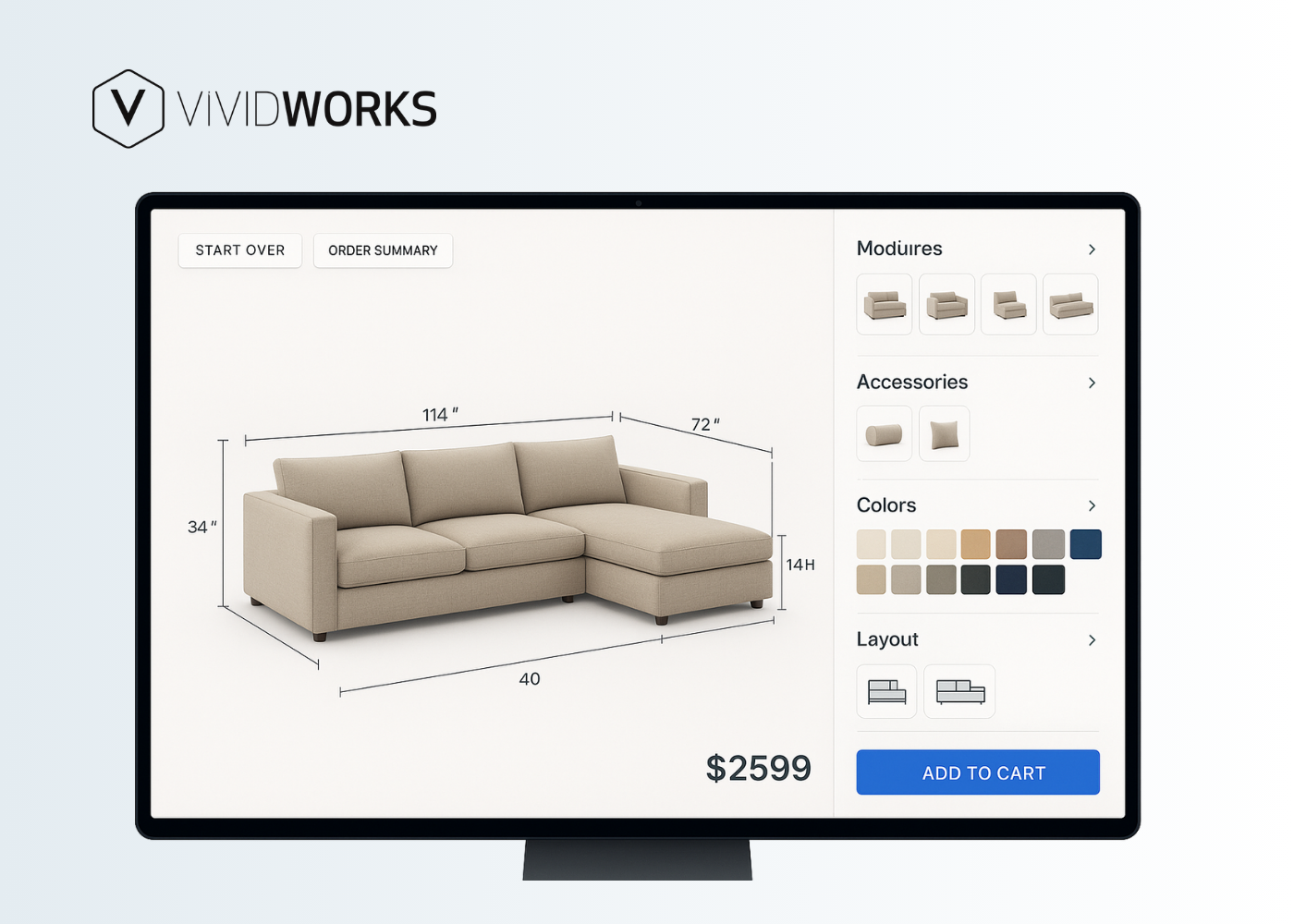

Across furniture, kitchens, baths, automotive, and more, demand for personalized products in eCommerce is growing fast. Customers increasingly want to see, customize, and feel confident about what they’re buying before they add it to their cart. That’s exactly what 3D product configuration technology enables: real-time product visualization and full control over their custom choices. Right now, let’s keep scrolling to discover more with our experts!
What Is 3D Product Configuration?
3D product configuration is the process of allowing users to configure products on their own and instantly preview them from all angles before purchasing. In this way, a 3D product configurator is a practical application that enables this to happen seamlessly and accurately.
Unlike traditional product pages that rely on static images or basic dropdown menus, this interactive product customization method creates a highly immersive shopping experience. Customers can explore their bespoke design in detail, helping them better understand the final product and make more confident purchasing decisions. This is especially valuable for products with complex, highly modular designs, where visual clarity is critical to evaluation.
How Does a 3D Product Configurator Work?
Behind every smooth experience on configurable products is always a coordinated set of technical perspectives. Here is how each one contributes to help achieve the best results.
1. 3D assets
High-quality, optimized 3D assets are usually the foundation for a successful 3D configurator. They determine how accurately your products are represented and directly influence the user experience. Choosing the right 3D file format is also important, as it affects loading speed, rendering performance, visual quality, and cross-platform compatibility. Industry-standard formats such as GLB/glTF, OBJ, FBX, and USDZ are widely used thanks to the ability to deliver realistic visuals while ensuring smooth performance across devices and channels.
2. Product configuration rules
For complex, highly modular products like sofas, shelves, and cabinets, 3D configuration software that is built with strong product logic like VIvidWorks is especially important. These rules help define how customization options interact with one another. This prevents impossible or incompatible selections, keeping the online purchasing experience accurate and error-free.
3. Dynamic/Real-time updates
When users work with a 3D visual product configurator, they can get real-time product visualization and price updates for every custom choice. For example, the moment a buyer switches from oak veneer to walnut, the 3D visuals update in real time. And if that change makes a price difference, the total updates simultaneously. This strengthens customers’ purchasing confidence, reducing back-and-forth communications and speeding up decision-making.
4. Integration with existing systems
Adding a 3D product configurator to leading eCommerce platforms such as Shopify, WooCommerce, and Magento enhances both operational efficiency and the customer experience. The 3D sales configurator automatically synchronizes product options, pricing, inventory, and order data with your store, ensuring accurate information across all channels.
Integration with ERP, CRM, and manufacturing systems is also possible to automate data exchange, streamline order processing, improve inventory control, and reduce manual tasks. These integrations create a unified workflow that can connect product customization, production, and fulfillment, enabling greater accuracy, efficiency, and scalability.
Benefits of 3D Product Configuration
This section dives into the values that 3D configurators can empower customers and brands:
- Improved customer experience
Offering an interactive product customization experience turns a passive browsing session into an active and engaging one. Customers are more likely to spend more time with the product, understand their choices better, and feel genuinely connected to what they’re building. This level of transparency drives more informed decisions when shopping online.
- Higher conversion rates
This benefit is for manufacturers and sellers. When customers can clarify what they’re ordering in 3D, they feel more confident about making an order, resulting in higher conversions. Another striking insight is that one personalization element can help lift conversions to 3.2%. That’s why brands that sell custom products online consider adopting 3D configurators to enable both personalized shopping experiences and realistic previews.
- Reduced product returns
Returns are expensive and time-consuming for both businesses and customers. Most happen because the delivered product doesn’t match what the customer expects. With a dedicated visual product configurator, this risk can be controlled effectively. There will be no “I think this will look right”; it should be “I can see it looks right to order now”.
- Increased average order value
As essential online sales tools, 3D configurators have become a significant driver of revenue. Specifically, they are exactly recognized as a natural upsell engine for your product page.
As customers can configure the product themselves and explore custom options from every angle, they’re already invested in designing something that feels personal. That interactive shopping experience sets an early standard for premium pricing and higher-value orders.
How To Choose The Right 3D Product Configuration Software
Choosing the right platform means knowing what to evaluate. For a deeper dive, it’s critical to check the top features to look for in your 3D configurators, but here is a breakdown:
1. Real-Time Customization
Every custom selection should be updated with visuals instantly, without lag or a page reload. Delays can break immersion and signal to customers that the configuration tool isn’t clear, well-performing, or reliable enough to process an order, inviting cart abandonment.
2. 360-Degree Product Visualization
Customers should be able to rotate, zoom, and inspect products from every angle, especially complex, highly modular designs, such as cabinets, shelves, and storage solutions. This interaction provides a much clearer understanding of the final product than static images or traditional catalogs, helping customers make more informed decisions.
3. Dynamic Pricing
3D product configuration software needs to ensure that the price updates automatically as options are selected. This level of transparent pricing eliminates surprises at checkout and effectively speeds up the sales process. In fact, nearly 40% of shoppers cite extra costs as a primary reason for abandoning their purchase, signaling an urgent need for the right action.
4. Save and Share Configurations
Complex, high-ticket product designs often require time and deliberation. Therefore, giving users the option to save their drafts or share custom configurations via a unique link makes it easy to collaborate with family, friends, or design professionals to achieve the best results.
5. Augmented Reality (AR) Integration
Using augmented reality (AR) in 3D furniture configurators has become a go-to solution for many manufacturers and retailers.
By allowing customers to visualize custom products in their real-world context on a smartphone or tablet, they can better understand the fit before making a purchase. In other words, this approach helps reduce customer uncertainty around size, style, and placement, enhances customer confidence, and minimizes product returns.
6. Cross-Device Compatibility
The product configurator should deliver a consistent experience across desktops, tablets, and smartphones. Responsive performance enables customers to customize products smoothly, regardless of screen size or operating system, delivering a consistent experience.
7. User-friendly Interface
An intuitive interface is critical to keeping customers engaged. Clear navigation, organized customization options, responsive controls, and fast loading times help customers complete their configurations with minimal effort, improving both satisfaction and conversion rates.
8. API Access
Comprehensive API support allows businesses to integrate the 3D product configurator with eCommerce platforms, ERP systems, CRM software, PIM solutions, and manufacturing workflows. At their core, these integrations synchronize data to ensure a seamless process.
Real-World Examples of 3D Product Configuration
1. New Works Shelving System Configurator
New Works, a well-known Copenhagen-based design house. They sell a modular shelving system that comes with dozens of possible combinations, materials, and finishes, and clients struggled to visualize their designs. And the manual quoting and back-and-forth communication process was time-consuming and error-prone.
That’s why New Works partnered with VividWorks, one of the most reliable providers of 3D product configuration solutions for complex products, to solve this.
The shelving system configurator allows customers to freely select from the full range of custom components and modules in real time, with a 360-degree preview for comprehensive clarity. Additionally, AR integration enables visualization of the custom design at a true-to-life scale within their own spaces (e.g., stores). Thanks to these robust features, New Works has witnessed:
Manual work has been reduced by 80%, while customers gained a buying experience that is faster, clearer, and more confident. All of these proven results provide a strong example of how real-time 3D visualization in online configurators directly translates into sales outcomes.
2. Tesla Vehicle Configurator
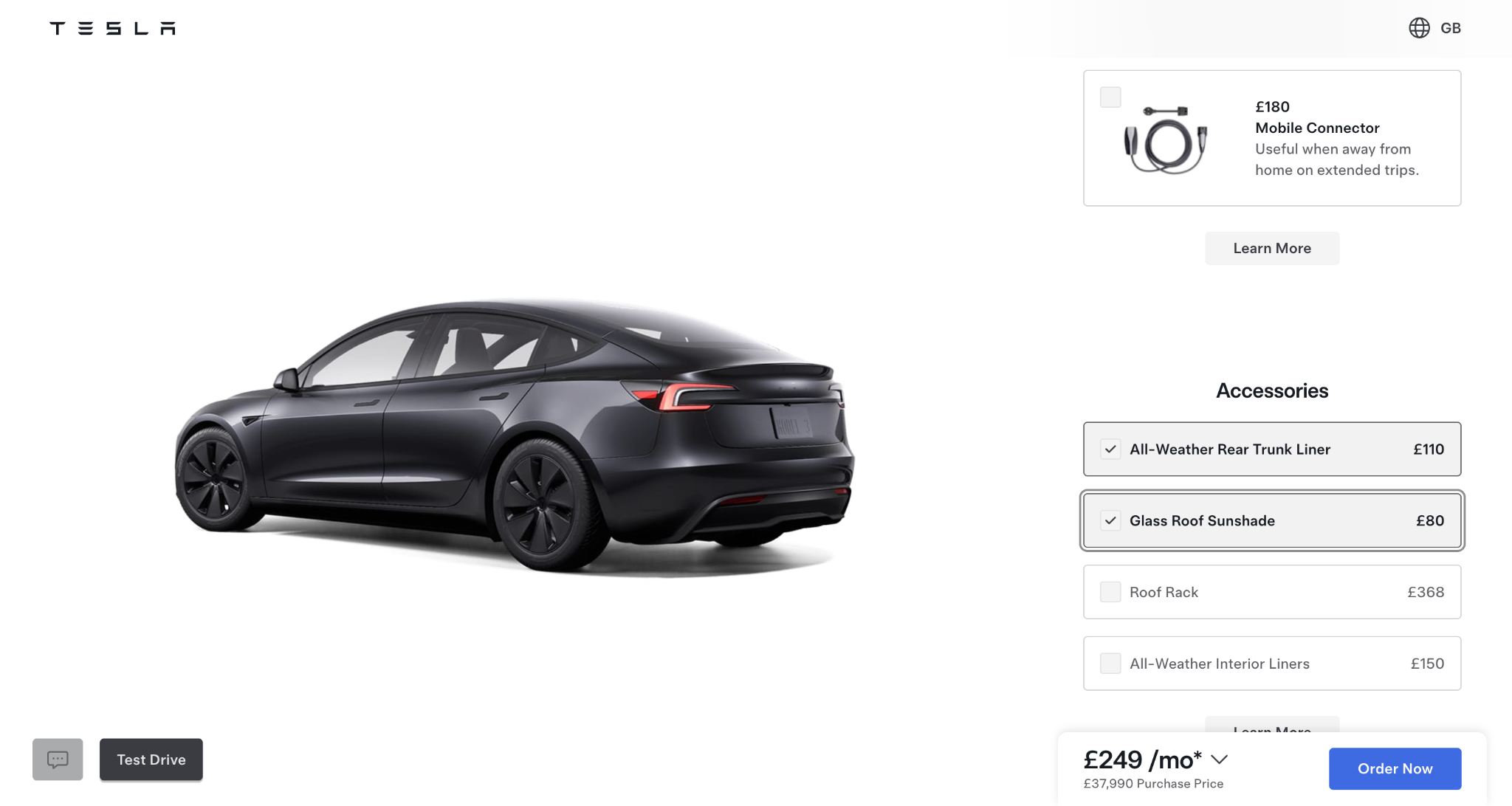
Tesla's online configurator is arguably the most recognized example in the automotive space. Customers start by choosing a vehicle model, then work through paint color, wheel style, interior options, and performance packages. Each selection instantly updates both the rendered vehicle image and the total price. This is a core part of a direct-to-consumer sales model and a reason customers feel confident placing five- and six-figure orders online.
3. Nike By You
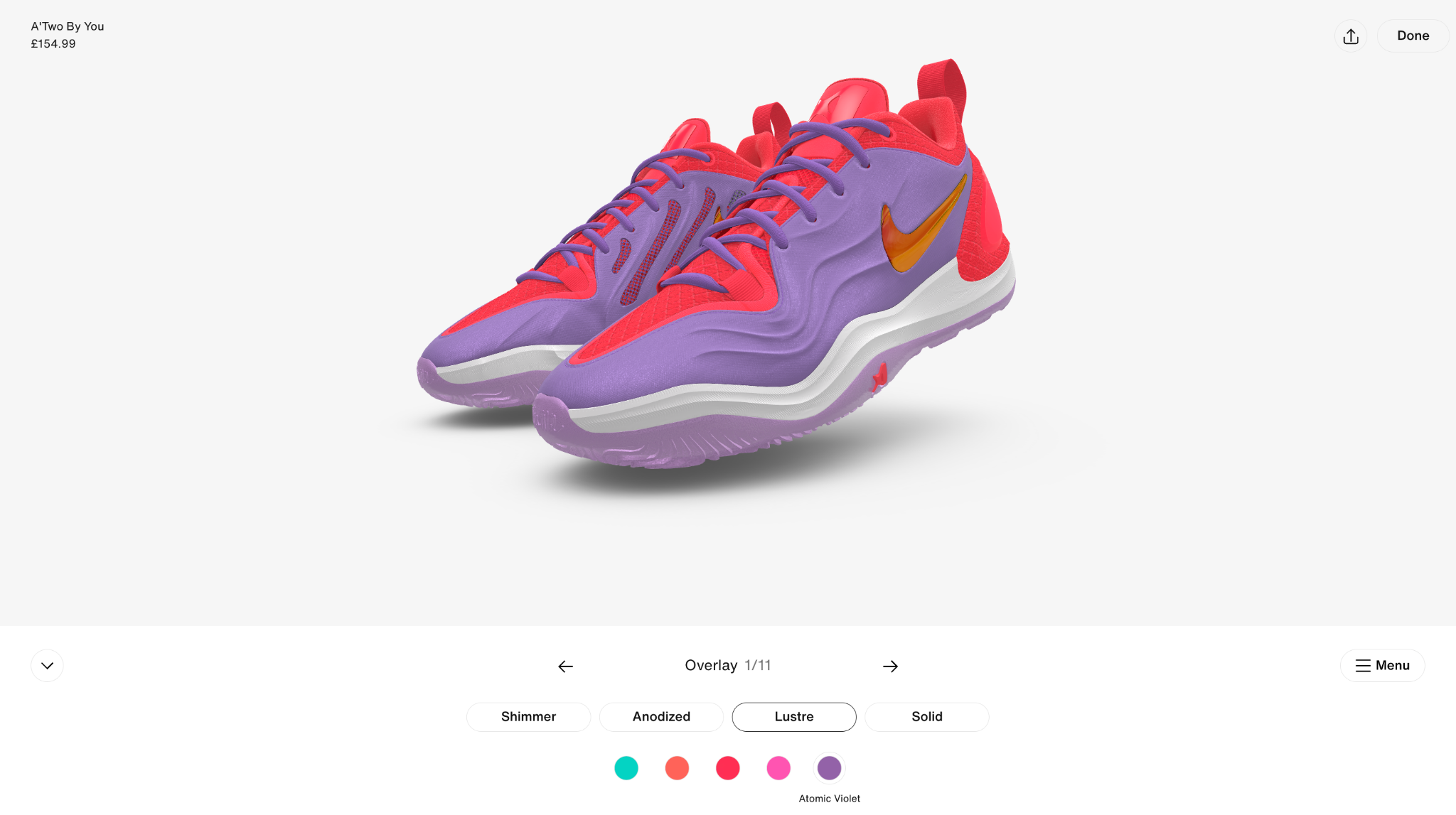
Nike By You lets shoppers design their own sneakers, choosing colors, materials, logos, and design details across dozens of components. What makes the experience work is that every change is immediately visible on a rotating 3D shoe. Product personalization at this level creates a sense of ownership before the product even ships. Customers who design something themselves are more likely to finish the purchase and far less likely to return it.
4. Bunker Storage 3D Room Planner
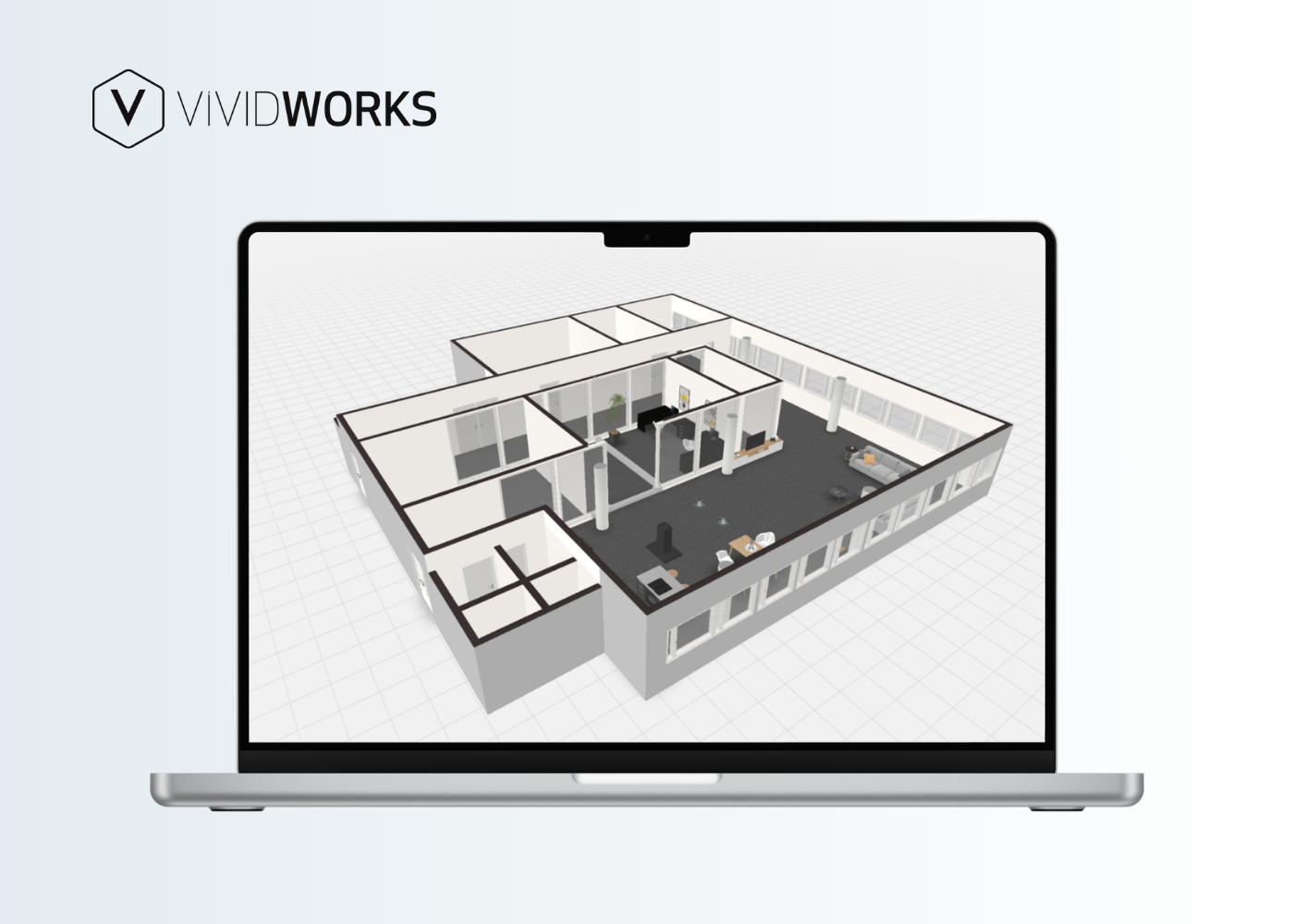
This 3D product configuration software empowers customers to create a full garage layout to see how every storage setup fits in a real space. You can have full design control over room layouts, specifications, colours, and elements.
If you feel confused about starting everything from scratch, you can use inspirations like L-room or Room 510 and refine them based on your demands. For greater clarity, try to keep and rotate the room from all angles.
Within the same interface, customers can also build custom modular storage solutions, including modular racking, workbenches, roller cabinets, and tool trolleys. By combining a 3D room planner with a 3D product configurator powered by VividWorks, Bunker Storage provides a seamless experience for designing both an entire garage layout and bespoke products in one place.
Conclusion
3D product configuration is a potential 3D trend for eCommerce retail and manufacturing that could help lead the market. It gives customers the real-time 3D visualization and product customization they now expect while delivering better conversion rates, fewer returns, and faster sales cycles. Whether you're selling furniture, modular systems, or complex goods, the right configurator changes how customers engage with and commit to your products.
Ready to see it in action? Book a demo and explore what's possible for your product catalog.
Table of Content
-3.avif)
Streamline your process today!


.png)

