


The holidays are one of the busiest times of the year for furniture stores. More and more people want to renew their home decor and cozy interiors to prepare for gatherings, making it the perfect season for brands and retailers to maximize their furniture sales. That’s also when you need furniture marketing solutions to lead the eCommerce market.
Below, we will break down 5 best furniture marketing strategies that you can run during the holidays to capture visitors’ attention, inspire purchases, and build customer loyalty:
- Rely on 3D and augmented reality technologies
- Focus on storytelling and social media campaigns
- Take advantage of AI tools/ experiences
- Optimize content marketing for mobile and seasonal SEO
- Release furniture discounts and promotions
Right now, let’s get into it!
Take A Look At The Holiday Seasons For Furniture
Data-backed overview of 2025 holiday eCommerce
The 2025 holiday season demonstrated the remarkable resilience and evolution of eCommerce across industries. According to Adobe Analytics on the US market:
- Consumers spent $257.8 billion online, an increase of 6.8% from 2024.
- Shoppers bought more during Cyber Monday, Black Friday, and Christmas.
- Personalized experiences, competitive discounts, omnichannel shopping, and Buy Now Pay Later (BNPL) were major drivers.
- Cyber Week remained the biggest value, bringing $44.2 billion online overall.
- The holiday sales were mobile-first, accounting for up to 56.4%.
A similar trend was observed in the UK eCommerce market, where mobile and BNPL spending increased by 14.1% and 2.2%, respectively, compared with 2024. Notably, AI-driven traffic to retail sites rose by 329% during the 2025 holiday season, highlighting the growing role of AI in product discovery and shopping journeys.
Furniture-specific insights
The points below are provided by Fortune Business Insights for a deeper understanding:
- The global furniture and home furnishing market was valued at $ 130.79 billion in 2025.
- Surge in consumer spending on home decor and custom furniture for personality.
- High demand for modular and stylish pieces of furniture.
- Furniture eCommerce is growing rapidly thanks to increased Internet penetration.
- The role of eCommerce and retail outlets was still highlighted.
- Kitchen cabinets were in significant demand in North America.
Key takeaways for success in 2026
- Start your campaigns early, between October and November.
- Prefer unique, personalized shopping journeys to engage customers effectively.
- Adapt furniture marketing approaches to diverse markets and audiences.
- Focus on delivering an mobile-first experience and flexible payments (BNPL)
- Combine personalization, AI, and 3D product technology for higher conversions.
Ultimately, preparing for BFCM and the 2026 holiday shopping season shouldn’t wait until the week of Black Friday. Furniture businesses should start planning campaigns several weeks out, building seasonal landing pages, updating existing Black Friday furniture deals and holiday content early. This gives search engines enough time to crawl, index, and rank seasonal content before shoppers begin their holiday research, while giving you more time to optimize product pages and campaigns.
Beyond content timing, a strong furniture holiday sales plan should include well-designed promotions, product bundles, sufficient inventory, retargeting campaigns, and shipping logistics to prepare for peak demand. With these foundations in place, let’s move on to the next part for the best strategies in detail.
5 Best Furniture Marketing Strategies For Holiday Sales
1. Enable an interactive, personalized shopping journey with 3D & AR
The first idea for digital marketing for furniture stores is to utilize technologies like a 3D product configurator, Augmented reality (AR), and a 3D room planner to deliver an enjoyable shopping journey for every furniture shopper anytime; it is not just for holidays. Let’s look at the 3 most powerful implementations with us below:
3D Product Configurator
When you sell configurable and custom products, working with 3D configuration platforms can turn a complex buying experience into a more interactive experience. They allow shoppers to design their own furniture by selecting colors, layouts, and materials; combining components; and adding add-ons if necessary. At the same time, you can instantly preview customization selections from all angles.
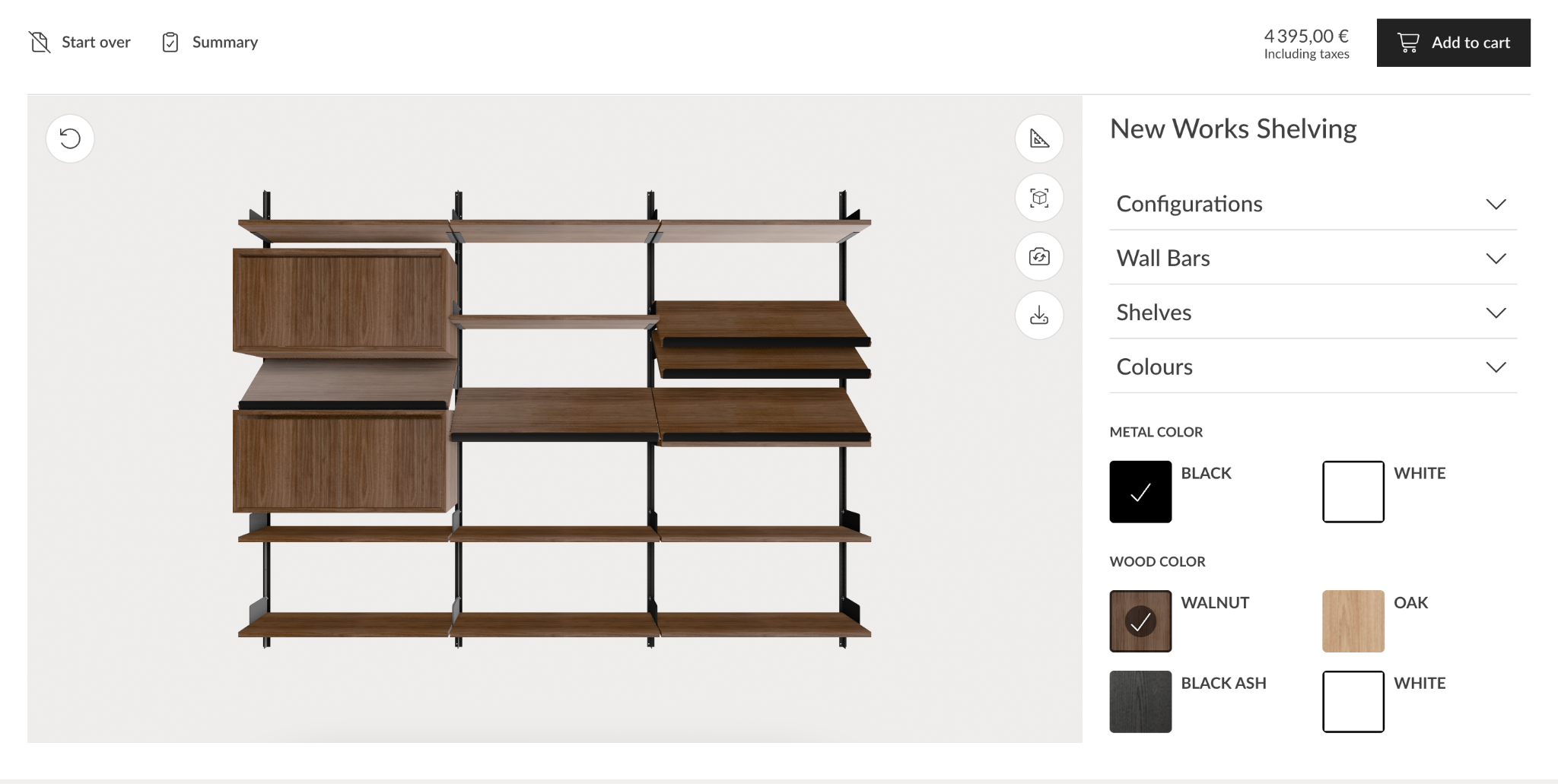
This helps you better understand what the finalized design will look like, which is necessary to reduce buying uncertainty, boost conversions and sales, and minimize product returns.
Pre-built product logics, dynamic pricing, seamless integration with back-end systems, and mobile responsiveness are the top features that great 3D configurators should offer. Therefore, if you want to invest in this innovation to transform furniture e-commerce marketing and sales performance, make sure to evaluate and combine these capabilities. In this way, furniture businesses can deliver a sales-driving, customer-centric experience.
AR Technology
Using AR is another excellent furniture marketing idea that can improve customers’ final decisions. This technology empowers the ability to place the desired furniture piece directly in the real–world environment, either in homes or offices, using mobile devices. As a result, everyone can precisely check the scale and fit of each item within their decor.
More importantly, AR for furniture eliminates the need for customers to visit physical showrooms to “test” furniture before buying. This saves significant time for both merchants and buyers, especially during the busiest times, such as Christmas, Cyber Monday, and Black Friday.
One of the leading providers of 3D and AR furniture marketing solutions, VividWorks, can effectively deliver all of these immersive shopping experiences. Beyond the fundamental functions, VividWorks has integrated Visual Configure, Price, Quote (Visual CPQ) into its 3D configurators so that customers can see price updates as they customize furniture. Once the design is finished, VividWorks displays a QR code to launch an AR experience.
Another standout capability is rule-based configuration, a powerful feature for brands offering complex or modular furniture designs like shelves, cabinets, or retail displays. This ensures every customization stays within production and design rules, reducing errors while giving customers maximum flexibility in personalizing their furniture pieces.
Blå Station, a Swedish B2B furniture maker, used to face a challenge with its highly modular BOB sofa system: near-endless configuration options made it hard for customers to visualize valid combinations. That’s why the business partnered with VividWorks to adopt a 3D configurator, letting users browse, combine, and rearrange modules directly while built-in product logic ensured every design stayed valid.
“The planner truly brought product planning to our customers. With BOB, it became a central part of the customer experience. Everyone can use it. You don't need to be an expert. You can just have fun with the system." - Sebastian, Blå Station.
3D Room Planner
This 3D application truly takes personalization a step further by allowing users to design a fully furnished space in minutes. Here’s what 3D room planners can do to satisfy your needs:
- Accurately plan the layout and floor dimensions;
- Arrange multiple furniture items that align well with your preferences.
- Quickly experiment with diverse combinations with a virtual walk-through.
- Instantly view the total cost of your projected plans and products inside.
With furniture and home decor businesses, this advanced 3D software inspires creativity, boosts visitor engagement for longer on-site time, and further drives higher basket sizes. Bunker Storage is one of the most successful case studies of how VividWorks 3D room planner transforms the buying experience. Customers can build their own storage setup, customize individual components, and create a full garage layout to visualize how everything fits together in their actual space.
2. Run holiday storytelling and social media campaigns
The next holiday marketing idea is to combine storytelling with social media marketing for furniture stores. During the holiday season, you aren’t just selling furniture; you should sell a “cozy holiday family moment” to effectively capture visitors’ emotional connection. A social media presence on Instagram, Facebook, LinkedIn, Reddit, Houzz, or Quora is a great approach to crafting compelling narratives that resonate with your target audience.
- Use behind-the-scenes (BTS) videos: Showcase how your custom furniture pieces are made with clear phases or how your teams prepare for furniture sales.
- User-Generated Content (UGC): Encourage customers to share photos of your products in their space (e.g., homes, offices, gardens). This is essential to leverage social proof and inspiration for other furniture shoppers and establish their trust.
- Interactive polls and reels: Gather valuable insights on their holiday decorating.
3. Utilize the power of AI
AI is a new but promising concept of modern digital marketing for furniture stores. Thus, the adoption of AI in furniture marketing for holiday seasons is a necessity for success. Below are some aspects that you should consider when integrating AI into your strategy.
- Provide 24/7 AI chatbots with questions related to specs, shipping, and returns.
- Use AI-powered algorithms to analyze a customer’s browsing history and suggest furniture pieces they are most likely to buy, similar to what Wayfair Muse offers.
- Take advantage of AI tools to launch ad creatives and copy for better conversions.

4. Offer early-bird discounts, promotions, and bundles
While this furniture marketing strategy is typical, few furniture brands can succeed with it. Furniture is a highly considered purchase, so discounts need to be timed perfectly. That’s why you should get inspired by some tricks to achieve as many sales as possible.
- Early-bird offers are available for planners in October/November.
- Offer bundled deals like a dining table and chair set at a reduced price.
- Enable free shipping for high-ticket items or bundles directly on product pages.
- Create limited holiday editions or countdown timers on your websites.
- Display newsletters for signups to get discounts on your homepages.
5. Optimize furniture eCommerce marketing for mobile & seasonal SEO
Here’s our optimization checklist that you can follow to perform this furniture marketing:
- Optimize your store and 3D configurators for desktops, phones, and tablets.
- Create landing pages and campaigns around keywords, such as “Holiday furniture sale,” “Best furniture for Christmas gatherings,” or “Black Friday furniture deals.”
- Publish gift guides, trend pieces, and holiday decor inspiration blogs to attract organic traffic while positioning your furniture brand as a go-to style authority.
Conclusion
The holiday season is a unique and excellent opportunity for furniture marketing to shine. 3D configurators, AR, 3D room planners, AI-powered experiences, SEO—and mobile—optimized strategies, and social media presence are the holiday marketing ideas that every furniture marketer and seller should consider to transform sales performance. In short, an effective marketing plan for holiday days focuses on creating an emotional connection with customers, making them feel confident and inspired by their purchases.
Talk to us today to discover how 3D product configurators leverage furniture shoppers’ experience, maximize AOV and revenues, and especially offer a competitive advantage
Table of Content
-3.avif)
Streamline your process today!



.png)
