The demand for product personalization has significantly shifted how eCommerce works. Whether it’s custom-engraved jewelry, personalized apparel, or made-to-order furniture, it should reflect customer preferences. In this way, you can effectively differentiate yourself from competitors, boost customer engagement, and increase average order value (AOV).
Thus, for Shopify sellers, this trend presents a golden opportunity. To sell custom products on Shopify, you need to know more than setting up default variant dropdowns. This blog covers everything: the product types worth customizing, how Shopify enables eCommerce customization, the best tools that make it work, and a detailed guide for the best results.
Right now, keep scrolling to discover more!
Why Sell Custom Products on Shopify?
Growing demand for personalized products
According to McKinsey’s Next in Personalization, 76% of buyers get frustrated when they don’t see any personalized interactions with the brands. This is no longer a niche preference; it’s a majority of your potential customers walking away when their expectations aren’t met.
The market data also backs it up at scale. For example, while the global personalized gifts segment is projected to grow at a 11% CAGR through 2032, the print-on-demand industry, a subset of custom selling, is forecast to grow at 24.81% annually to $118.85 billion by 2035.
Additionally, 95% of senior marketers consider their personalization strategies successful, helping their businesses transform sales and lead the market. And 49% of consumers admit they are more likely to repeat their purchases after having a personalized shopping journey.
Benefits for merchants
When you sell custom products on Shopify, you can get a broad range of benefits, such as:
- Competitive advantage: Custom merchandise is hard to copy due to its uniqueness, elevating your business above race-to-the-bottom pricing on generic products.
- Higher profit margins: Made-to-order products command high-end price ranges. Once you can offer interactive, personalized purchasing experiences, customers are willing to pay more for something unique, and you can effortlessly increase profits.
- Improved customer loyalty: Shoppers who can design their own items or receive personalized products are emotionally invested and far less likely to return or churn.
While the benefits are substantial, unlocking the full potential of eCommerce product customization is not easy. That’s why learning how to sell unique custom online is crucial, especially for beginners. It is not only about choosing a proper product for your business, but also about ensuring a seamless shopping experience and efficient order management.
Types of Custom Products You Can Sell on Shopify (300 words)
1. Custom apparel
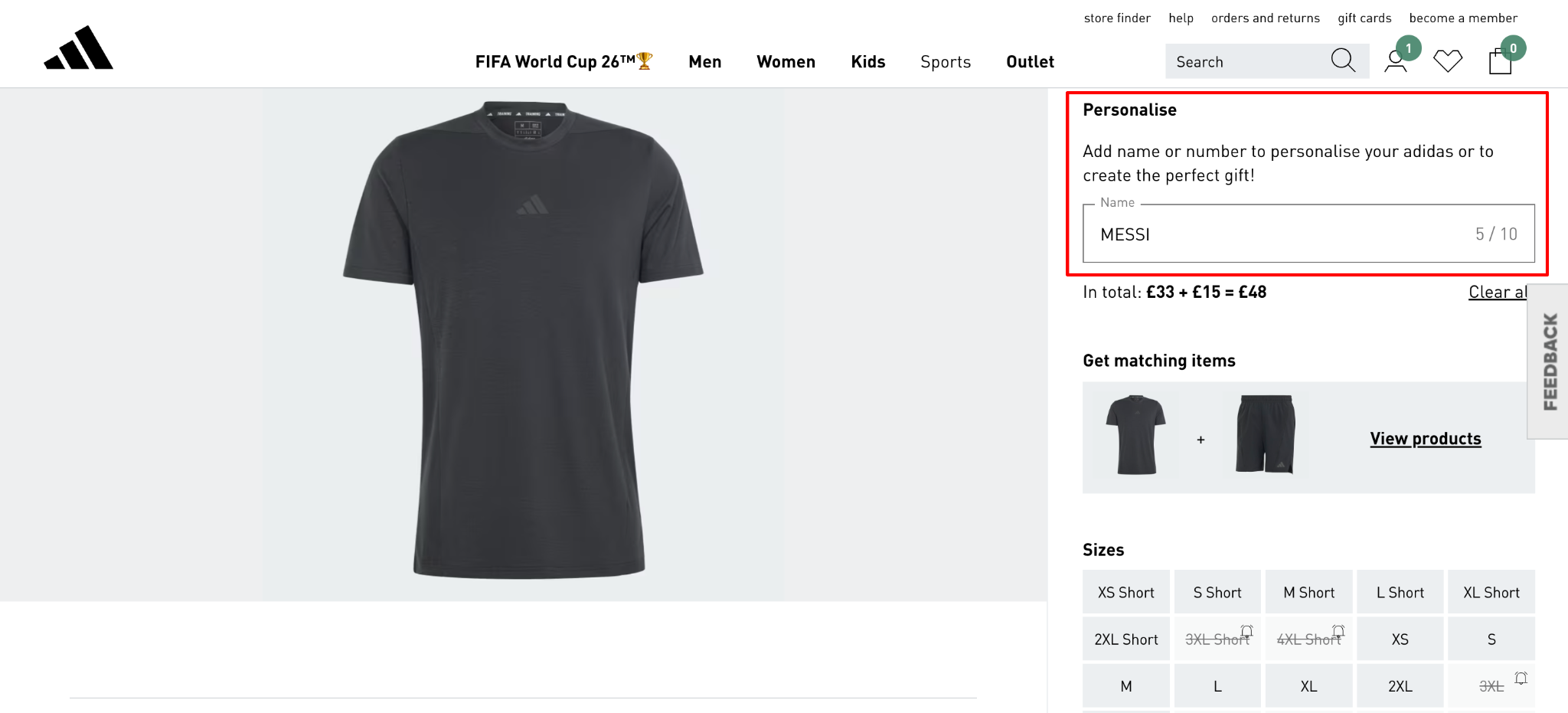
T-shirts, hoodies, sweatshirts, and hats are top-selling products in this niche. Customers tend to personalize them with names, slogans, logos, or artwork, making them ideal for fan merch, team uniforms, family memories, branded corporate wear, and niche lifestyle brands.
2. Personalized gifts
Mugs, photo books, candles, ornaments, drinkware, and blankets are viral personalized gifts that transform an ordinary item into a meaningful keepsake. This market often peaks during Q4, but year-round demand exists around birthdays, anniversaries, and corporate gifting.
3. Engraved products
Custom engraving is commonly found on jewelry, cutting boards, wallets, keychains, glassware, and corporate awards, unlocking the highest profit margins in custom retail. They also have a strong B2B market: trophies and plaques generate reliable bulk-order revenue.
4. Made-to-order furniture
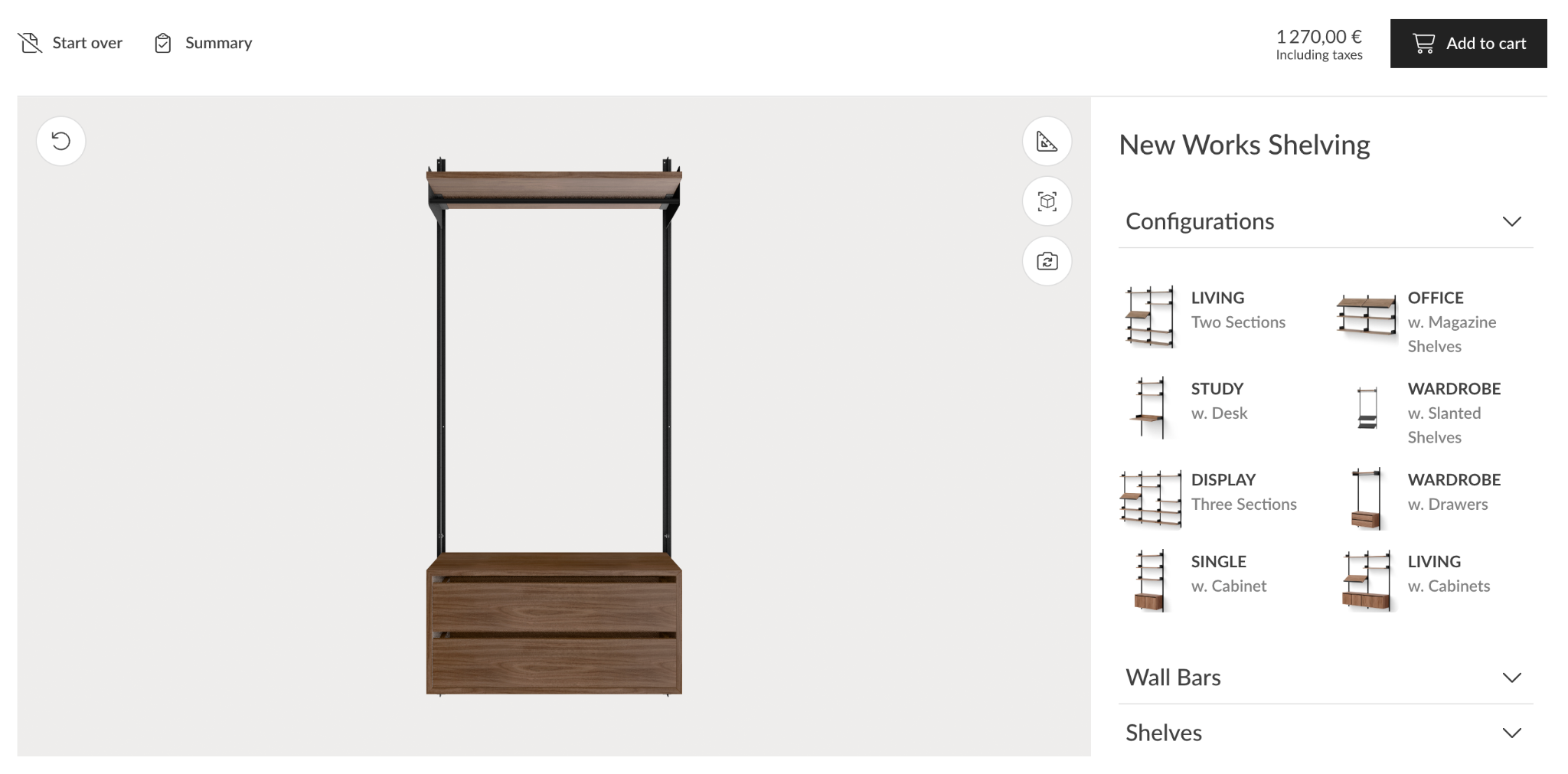
This niche works especially well because it falls at the high-end of Shopify customization. Customers configure dimensions, materials, finishes, and level up the functionality with add-ons, ensuring the product is built only after a custom order is confirmed. This helps manufacturers and retailers reduce overstock risk entirely and supports premium pricing.
5. Print-on-demand (POD) products
The POD model is where products are printed and shipped only after a purchase is made. Top-performing categories include phone cases, tote bags, wall art, picture frames, and stickers. POD Services currently offers flexible options, from small testing to bulk production.
How Shopify Supports Product Customization
Shopify provides the fundamentals for selling custom items. Let’s take a quick look below:
- Native product options
Shopify’s built-in system supports product variants like size, material, and color. However, you’re still limited by the number of custom product options and combinations per store. Therefore, if you’re running a small business, this works. For complex setups, it doesn’t truly.
- Shopify apps
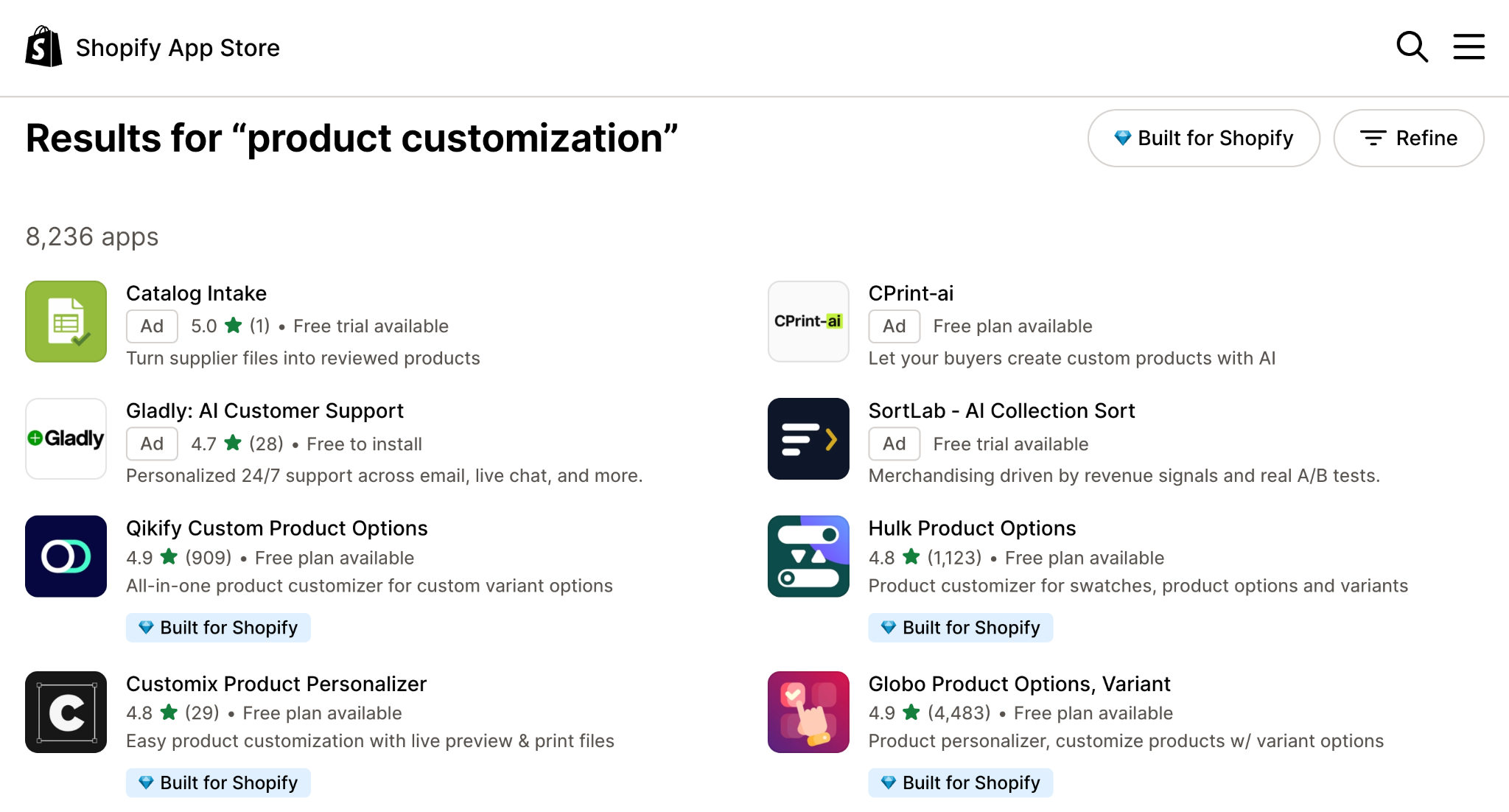
The Shopify App Store has 8,000+ different apps, where the real marketing, sales, storefront optimization, order management, and customization power lives. That’s why we recommend choosing the best Shopify apps for custom products to extend what’s natively possible. From that, you can add text fields, file upload portals, conditional logics, and even live prices.
- Third-party integrations
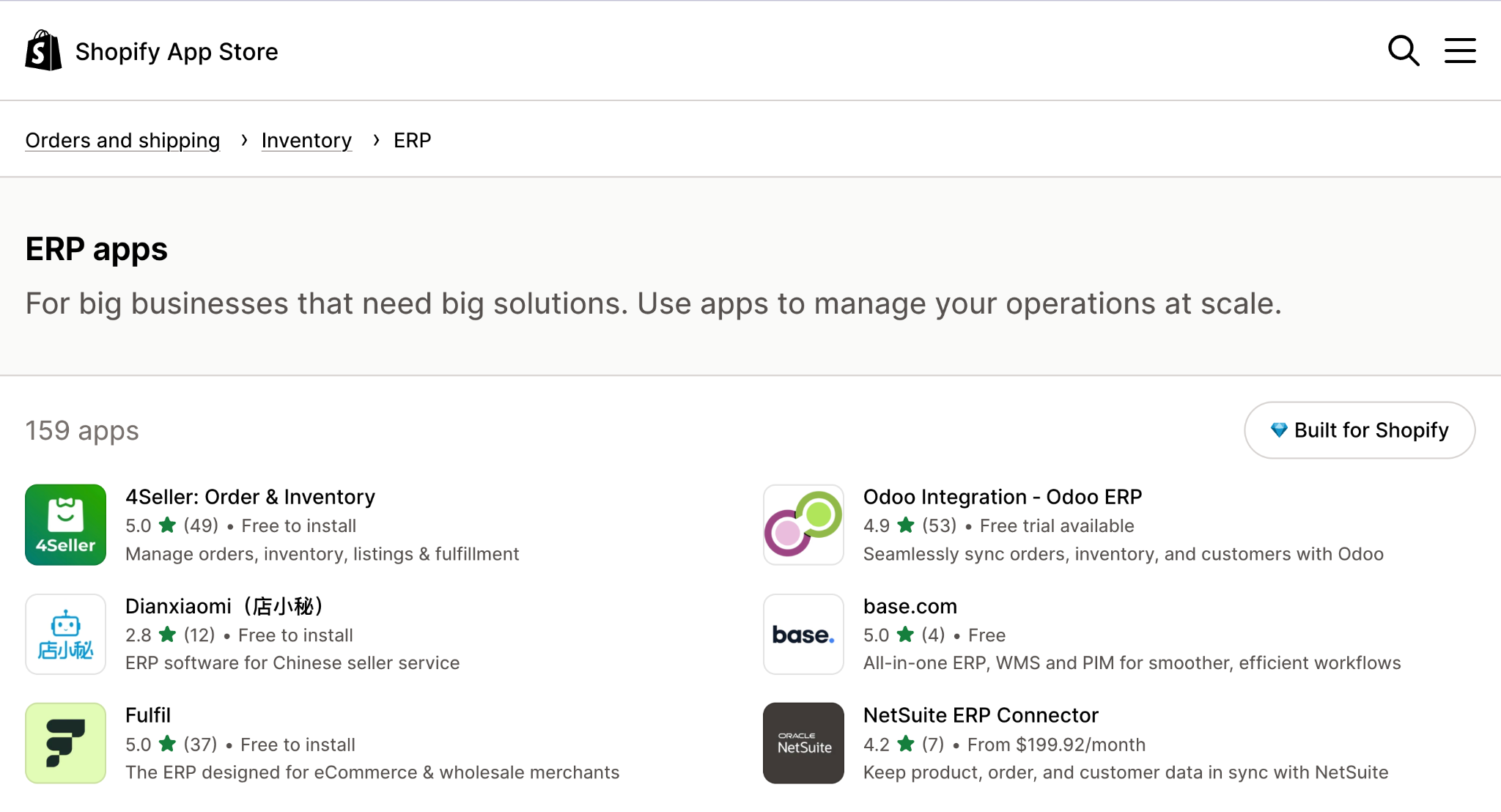
You can also consider integrating your Shopify admin dashboard with a third-party provider through APIs to support complex orders. For example, adding a Shopify product customizer app helps offer real-time product customization experiences and enhances visual previews. Another integration involves ERPs and CRMs to generate a smoother, more robust workflow.
Using a Shopify Product Configurator
A Shopify product configurator is tailored software that allows users to build a product directly on the Shopify product page. They can effortlessly build and design their own product by choosing materials, dimensions, layouts, add-ons, and more, and see instant, accurate visual updates. Along with this preview, buyers can clarify real-time pricing, so there are no surprises at checkout. This significantly reduces hesitation and cart abandonment, especially for high-value orders.
It is apparent that both customers and merchants benefit from visual product configurators. For customers, they have their desired products and know exactly what they’re getting before they order. For merchants, they can minimize returns and customer service queries, ensuring cleaner product data flowing directly to fullfillment without manual transcription. These make product configurators one of the best online sales tools for custom businesses.
Step-by-Step Guide to Selling Custom Products on Shopify
Step 1: Choose Your Custom Product
You can’t sell custom products on Shopify if you don’t know which niche or product type you truly target. You can choose one from the recommended product types above or items where personalization meaningfully increases perceived value and makes buyers pay more.
Step 2: Set Up Product Options
In your dashboard, you need to create your base products and define product variants for the options you can handle natively. For anything beyond that or requiring complex setups, let’s consider adding an app or a proper provider to deliver these personalized experiences.
Step 3: Install Product Customization Software
When you sell custom orders with complex, highly modular, visually configurable designs, building and implementing a product customizer is critical. VividWorks Shopify product configurator is currently listed among the highest-performing platforms for these use cases.
It stands out with 3D real-time customization and visualization, as well as the Visual CPQ feature that configures, visualizes, and displays prices simultaneously. As a result, customers can interact with their desired products from all angles, rotating, zooming, and switching features while knowing exactly the final prices before they move forward to making orders. Notably, CRM and ERP integration enables a unified workflow and improves inventory management. In fact, this 3D configurator can also work with Magento and WooCommerce.
Step 4: Optimize Product Pages
The product page is where products are won or lost. Besides interactive previews, focus on:
- Writing descriptions that speak to the outcomes/benefits, not the features
- Showing social proof from customers who previously personalized products
- Making the configuration interface intuitive
- Including trust badges, flexible payments, and clear information on product quality.
Step 5: Manage Custom Orders
Let’s take a look at the following considerations to ensure the best results for your business:
- Track more on raw materials instead of finished goods
- Define clear handoff points between the order system and the product team
- Enable BOM configurators, which include a strong built-in bill of materials (BOM) feature, ensuring the right components are automatically queued for each order.
- Connect Shopify to CRM and ERP to scale custom order processing without errors.
Conclusion
Now that you have already understood how to sell custom products on Shopify. With this foundation, hopefully, you can engage potential customers from the early days, differentiate your brand, justify premium prices, and build loyal customers. The facts have spoken: product personalization drives conversions, repeat purchases, and brand advocacy, but the key to success lies in aligning your business plan, resources, and toolset with your products.
Book a demo today to discover more about how 3D configurators support custom sales.
FAQs
- What are custom products on Shopify?
Custom products are items customers can personalize before purchasing. They can choose text, colors, dimensions, materials, layouts, or uploaded designs, based on their preferences.
- Can I sell personalized products on Shopify without coding?
Yes. Several no-code apps enable eCommerce customization, but most offer only basic options or limited configuration for custom orders. If you prefer to offer more engaging, immersive experiences, let’s consider partnering with trustworthy services like VividWorks. They are highly recommended for use in complex, highly modular designs, like furniture.
- What is a Shopify product configurator?
A Shopify product configurator is built for Shopify stores, letting users visually design a product on their own and see a live 3D or 2D preview alongside accurate updated prices. Additionally, it is often designed with a strong rule-based configuration to minimize errors.
- What are the best products to customize and sell on Shopify?
The first step in how to sell customized products on Shopify is selecting the right product. You can choose from the most common options, such as custom engraving, personalized gifts, made-to-order furniture, and POD products. But B2B niches are also strong candidates.
- How can I automate custom order processing on Shopify?
You can connect your dashboard and configurator with your ERP system so custom orders flow directly into your production flow. In this way, you can effortlessly ensure the right materials are allocated automatically, eliminating manual re-entry as order volume scales.
Table of Content
-3.avif)
Streamline your process today!