


The future of sales in the furniture industry has been shaped by digital-first customers, advanced visualization tools, innovative technologies, and data-driven decision-making. Buyers now expect personalized products, transparent pricing, immersive experiences, and the ability to move seamlessly between online and offline channels. That’s why you need to rethink your furniture sales strategy, adopt modern sales enablement tools, and align with broader future of retail sales trends to drive more profits and lead the market.
This article examines seven powerful trends shaping furniture sales in 2026 so that you can get inspired and have the best preparation. Now, keep scrolling to discover more!
1. Furniture Configurators Become A Standard Tool for the Future of Sales
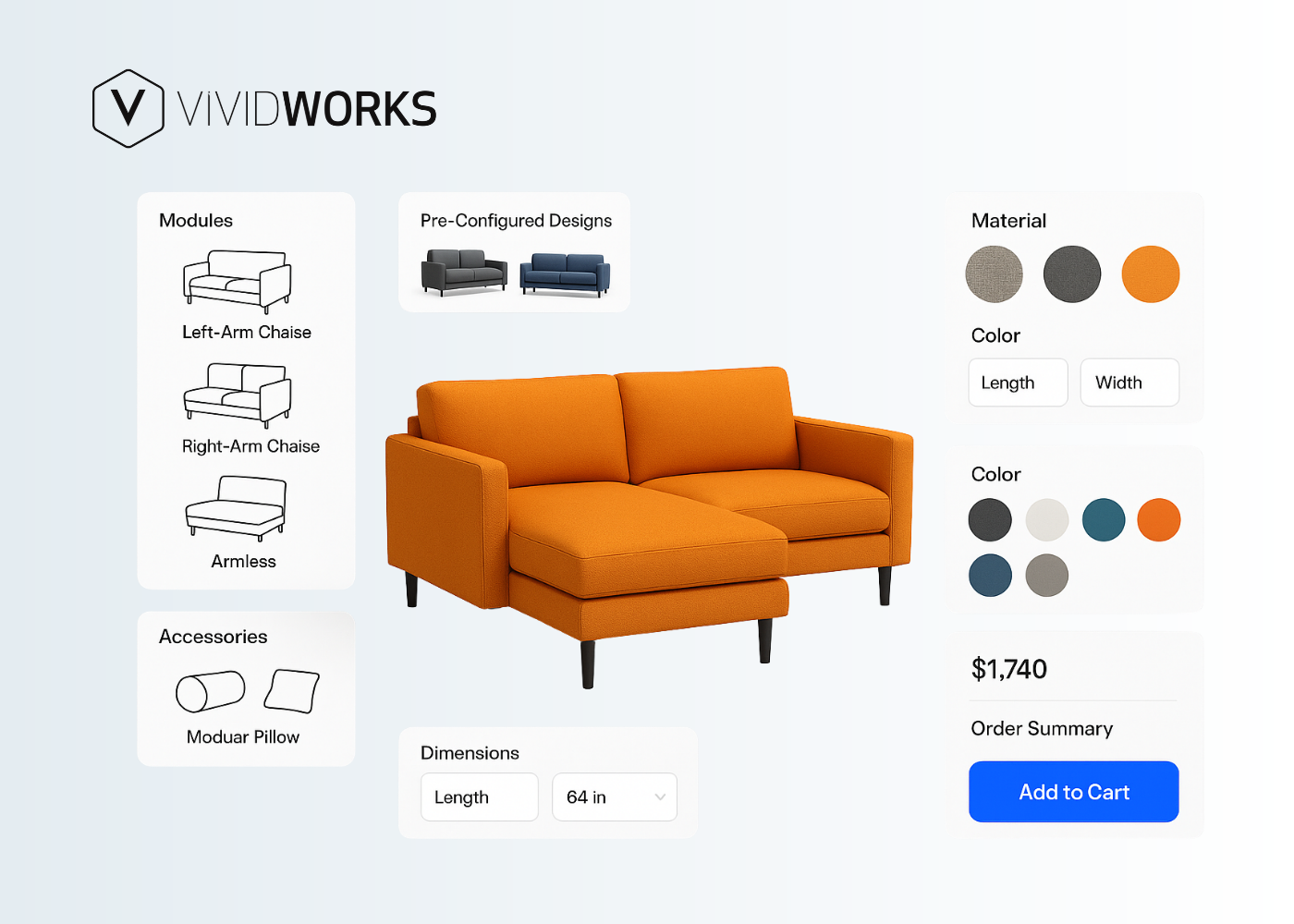
Though furniture configurators have emerged in recent years, they are quickly becoming a cornerstone of the future of sales for furniture businesses. These tools enable buyers to customize product options, including materials, finishes, dimensions, add-ons, and colors, depending on their interests, and accurately display their selections in real-time. Another striking point is that 3D configurators can offer 3D visualizations from all angles.
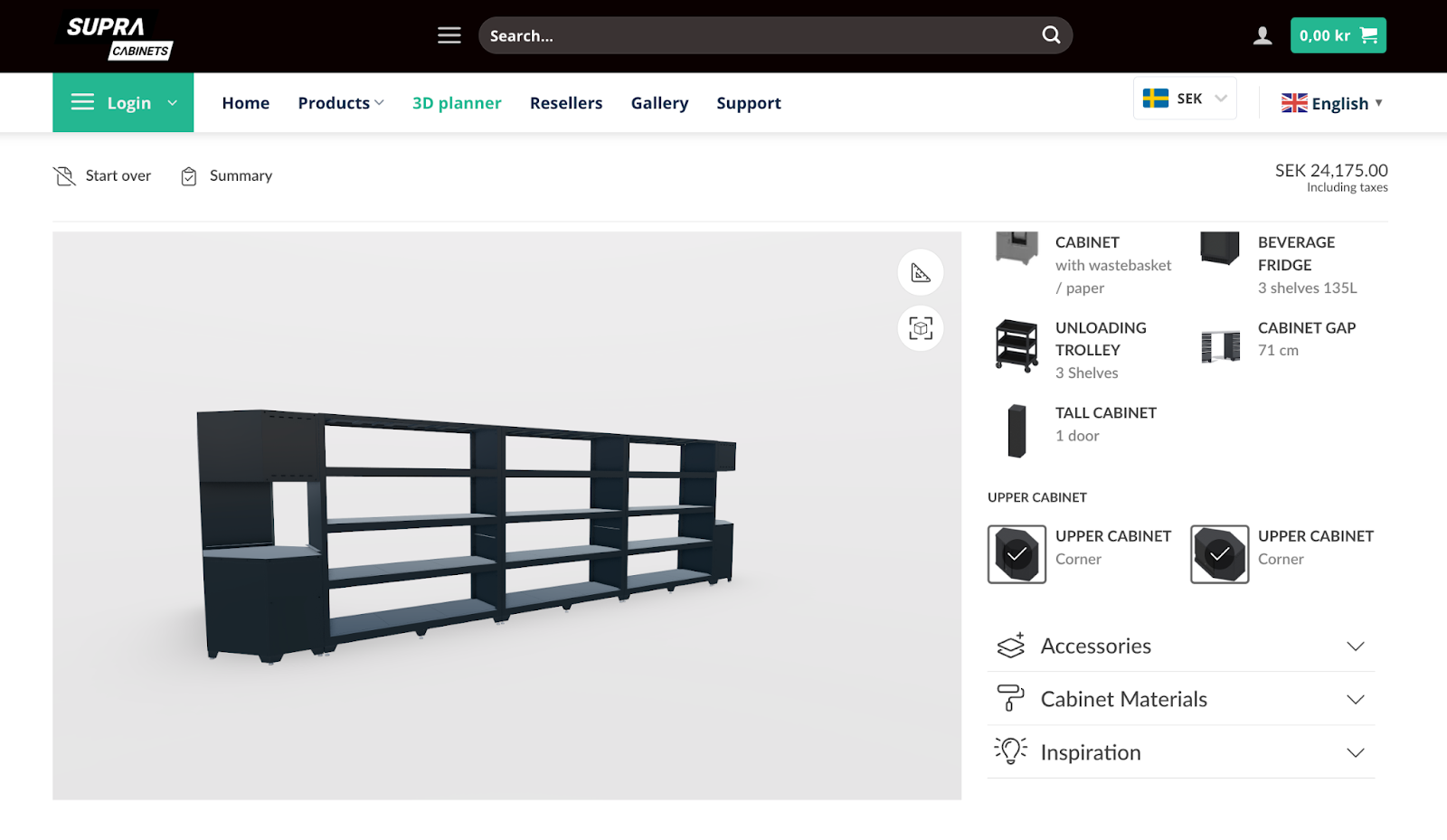
Why it matters:
While there has been a rapid rise in online shopping demand following the COVID-19 pandemic, it’s not easy to close sales with furniture clients. The online shopping cart abandonment rate is 70.19%, which is even higher for high-consideration products, such as furniture. Apparently, if you focus solely on physical stores, you might fall far behind. Otherwise, to attain both online and offline sales efficiency, you need a proper strategy.
Adopting a 3D furniture configurator is now a strategic approach that not only engages customers initially but also drives qualified furniture leads for both B2C and B2B markets. Customers have immersive experiences, interact with products they design themselves, and gain a deeper understanding through 3D previews. More exposure, less hesitation, and as a result, you can close more furniture deals. That’s why this tool is also known as one of the core sales enablement assets for building a competitive edge in the long run.
Pro Tip:
- Select a reputable configurator provider in the furniture industry, like VividWorks.
- Clarify customization options that you will offer customers.
- Consider innovative features, such as dynamic pricing, 3D room planning, etc.
- Ensure an intuitive, smooth interface for every user.
- Pre-check the ability to integrate with CRM, ERP, and eCommerce platforms.
2. CPQ Software Supports Dynamic Prices and Quotes for Better Sales Efficiency
CPQ simplifies complex pricing and quotes in real-time, ensuring accuracy and speed. It is essential for every size of furniture business, thanks to its automation ability for every input from users (customers or salespeople), promising the future of sales enablement.
Best CPQ software, such as Salesforce CPQ, Oracle CPQ, and Zuora, is widely adopted across industries. Yet, in the furniture sector, many sales professionals use automation tools called Visual CPQ. Unlike traditional CPQ systems, Visual CPQ allows users to configure furniture visually while simultaneously seeing real-time pricing and generating quotes. This combination significantly boosts pricing transparency and reinforces client trust.
Why it matters:
The CPQ software market has been growing rapidly due to the increasing need for businesses to streamline their sales processes, with a CAGR of 10.5% from 2025 to 2030. Without CPQ software, pricing and quoting become fragmented across departments. Sales teams manually request prices, finance validates margins, and operations confirm feasibility; however, errors or delays are common. This further slows down the sales process and drives the risk of inconsistent pricing, incorrect quotes, and margin erosion.
Pro Tip:
- Integrate with CRM and ERP systems to enable a unified workflow.
- Consider implementing Visual CPQ for complex furniture designs.
- Prioritize cloud-based deployment to ensure real-time updates & online access.
- Select a suitable subscription plan that matches your volume requirements.
3. Augmented Reality Improves Customer Experience and Confidence
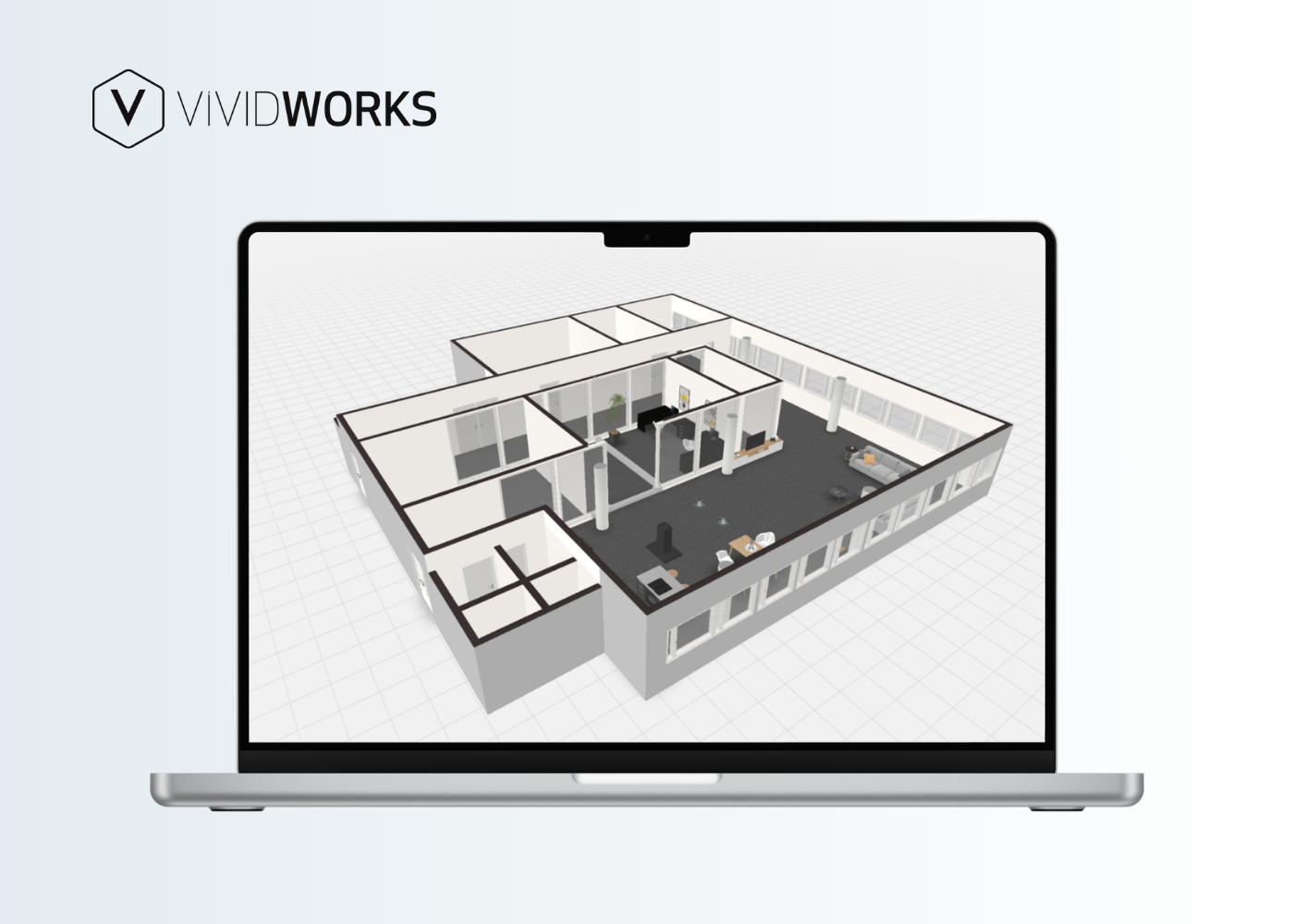
AR for furniture is the use of 3D technology to preview true-to-scale 3D furniture pieces directly in real-world environments, like homes and offices, before making a purchase. Customers effortlessly see how a product fits, looks, and interacts with their own space.
Why it matters:
According to a recent paper, 78% of shoppers report that they increase their confidence in online purchase decisions when using AR to visualise products in their space. This is a golden opportunity for brands that know how to implement and optimize the role of AR.
In the furniture industry, common problems can be “A sofa will fit their living room, that a dining table won’t overwhelm the space, and that colors and styles align with existing decor?” Previously, it was challenging to convey everything without clear illustrations. However, AR directly addresses these concerns by allowing customers to accurately, quickly, and easily visualize products only with a mobile device. As a result, AR eliminates customer uncertainty, making it a valuable sales closing technique for the future of sales.
Pro Tip:
- Combine with 3D furniture configurators to maximize customer journeys
- Highlight AR functionality prominently to increase usage
- Ensure AR can work well on both smartphones and tablets
- Brief on-screen prompts or tutorials to help first-time users clarify how to use.
4. Modular and Made-to-Measure Furniture Design at Scale
For modular products and those with numerous dependencies, such as furniture, having built-in rules within a sales tool can ensure implementation will takes less effort and investment. This further increases the average order value (AOV) while maintaining the highest level of accuracy. That’s also why many furniture brands consider this technical approach more significant for the future of sales.
Why it matters:
The furniture is modular, typically following a logical building structure with multiple dependencies between dimensions, components, styles, and materials. Defining and implementing this logic manually can be complex, time-consuming, and expensive.
Therefore, a tool with built-in logic, similar to that of the VividWorks product configurator for complex products, can significantly accelerate, simplify, and reduce the cost of this process. Designers and sales teams can reduce their time to validate each configuration, ensuring that every customer selection is technically feasible and ready for production.
However, this implementation is not typical for every niche. It particularly works well for furniture brands offering a wide variety of complex products, such as modular sofas, retail displays, storage cabinets, dining sets, and more. Therefore, to ensure a succesful furniture sales strategy, you need to consider your product complexity before starting.
Pro Tip:
- Build based on production feasibility, structural integrity, and material limitations.
- Prefer integrating pre-built logics for furniture or modular product configurators.
- Prevent invalid choices early rather than correcting them after they are made.
- Align logic with pricing and quoting workflows to maintain workflow accuracy.
5. Data-Driven Analytics Help Make Informed Decisions and Refine Your Sales Strategy
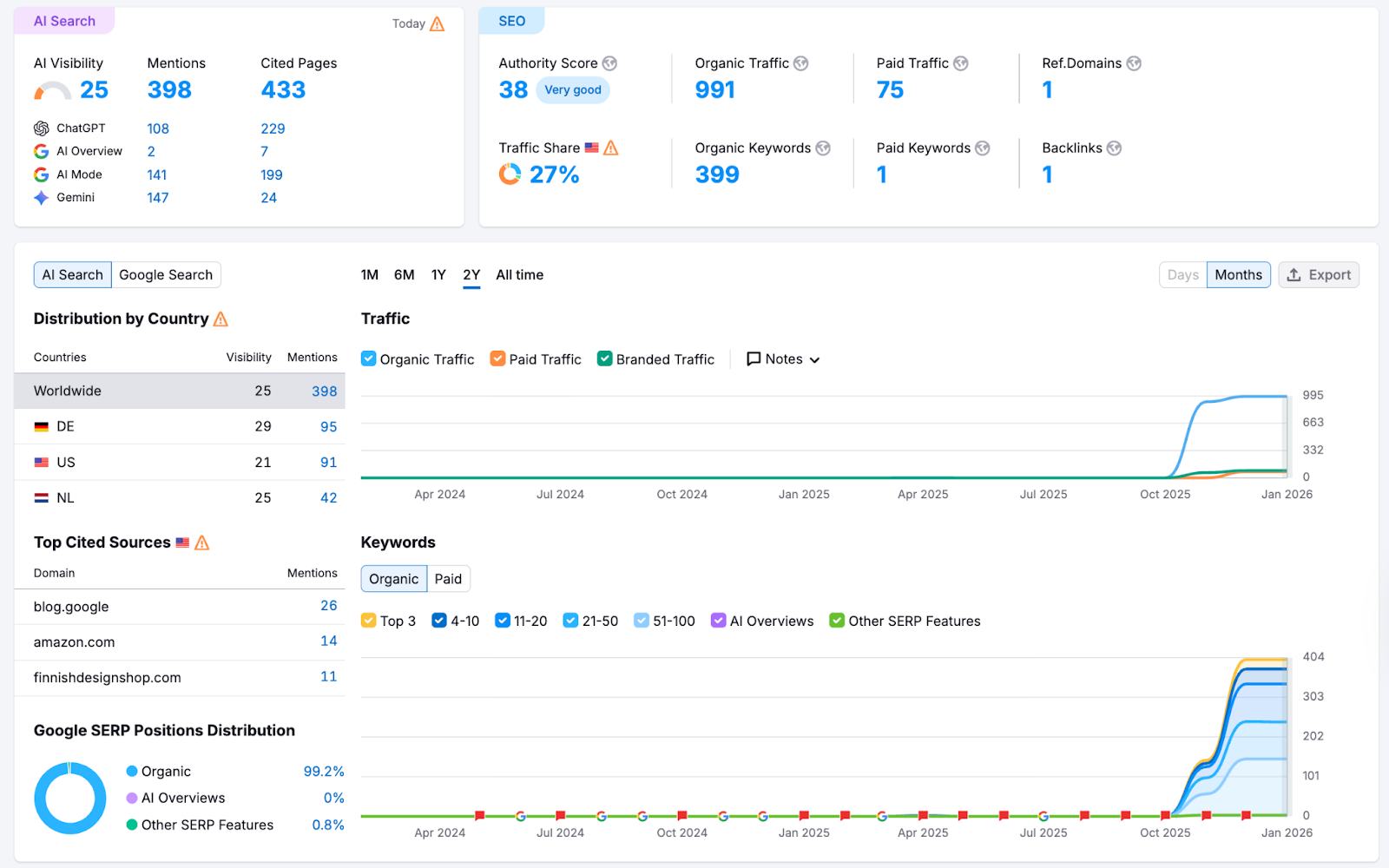
Data-driven analytics play a crucial role in the future of sales for furniture, enabling manufacturers and resellers to move beyond intuition and make informed decisions based on the real customer experience. By collecting and analyzing sales insights from configurators, eCommerce platforms, internal systems, and sales channels, you can gain a clearer understanding of shopper behavior, product performance, and market demand.
Why it matters:
Furniture sales involve high-value, high-consideration, complex purchasing decisions. Thus, small inefficiencies can lead to significant revenue loss. Data analytics helps reduce these risks by improving forecasting accuracy, personalization, and operational efficiency.
McKinsey & Company indicates that data-driven organizations are 23 times more likely to acquire customers and 6 times more likely to retain them compared to their competitors. In the furniture sector, where long sales cycles and high cart abandonment rates, as mentioned above, are common, this edge is particularly impactful for sales and profits. Therefore, through these insights, your sales, marketing, product, and manufacturing teams can optimize sales transformation strategies to boost sales productivity effectively.
Pro Tip:
- Centralize sales databases from configurators, CPQ, CRM, ERP, and other systems.
- Use analytics to optimize pricing strategies and options.
- Establish regular review cycles to refine sales strategy and inventory planning.
6. Omnichannel and Multi-Channel Selling to Maximize Sales Productivity
Omnichannel and multi-channel selling have become non-negotiable for the future of furniture sales, redefining how sellers engage with buyers during the buying journey. Customers tend to move between physical stores, brand websites, marketplaces, and social media platforms, often using multiple touchpoints before making a final decision.
Despite that, many sellers still get confused between omnichannel and multichannel. Omnichannel selling focuses on creating a seamless, connected experience across all channels, while multi-channel selling ensures presence across multiple platforms. Apparently, the core difference lies in the goal you want to attain through these methods.

Why it matters
Furniture shoppers typically conduct extensive research before making a purchase. They may discover a product on social media, explore customization options on a website, visit a showroom to assess the quality, and finalize the purchase online, or vice versa. Brands that may fail to connect these touchpoints risk losing visibility, trust, and ultimately, sales.
Another interesting point found by McKinsey & Company is that omnichannel customers shop 1.7 times more than shoppers who use a single channel. Additionally, social media is becoming an influential part of the furniture-buying journey. Roughly 44% of customers purchase furniture on social media channels, such as TikTok, Facebook, and Instagram, at least three to seven times per year, which is especially significant for furniture sales. Thus, investing in the quality of content, visuals, and ads on these channels is essential. Finally, don’t forget the role of micro-influencers and experts to boost your brand trust.
Beyond direct-to-consumer channels, selling through resellers has become important. Apparently, brands need to implement and pay for the 3D configurator separately for each reseller site, a costly and time-intensive approach that many providers still employ. However, with VividWorks, using 3D configurators for resellers becomes much easier. Furniture businesses can set up the configurator once and reuse it across multiple sites and sales channels. This approach is especially practical for scaling customization across global brands, reseller networks, and multi-store operations, while optimizing resources.
Pro Tip:
- Unify product data and pricing logic across all channels to prevent confusion.
- Utilize social media as a sales acceleration channel, not just for marketing.
- Scale furniture sales through resellers with the proper 3D configurator.
- Align internal teams around a unified customer journey with shared data.
Book a demo with VividWorks today to see how our 3D advanced technologies such as 3D configurators, Visual CPQ, and AR, help transform your furniture sales and performance. Moreover, read customer success stories to get inspired by leading furniture businesses!
Table of Content
-3.avif)
Streamline your process today!


.png)
