


The direct-to-consumer furniture model starts transforming how furniture brands design, market, and sell products. Instead of relying on wholesalers, distributors, or retail chains, manufacturers handle everything themselves. This aligns with broader D2C eCommerce trends, where brands aim to control customer relationships and optimize margins effectively.
This blog explores how D2C works, why it’s growing rapidly in the furniture industry, the best strategies, and top-rated technologies brands should adopt to lead the competitive market.
What Is Direct-To-Consumer (D2C) Furniture?
Direct-To-Consumer (D2C) furniture is a model in which a business or manufacturer owns every stage of its product lifecycle and sells products directly to customers. In other words, you don’t need to reply to any third-party distributors, retail stores, or wholesalers for sales. As a result, the entire customer journey, from product discovery to purchase and after-sales support, is well-designed to take place within the furniture brand’s own digital ecosystem.
eCommerce Direct-To-Consumer vs Retail Furniture Buying
Traditional retail relies on showrooms, salespeople, and layered supply chains. Customers drive to furniture stores, sit on samples, and wait several weeks or even months for delivery. Consequently, prices include retailer margins, and the final furniture costs remain higher.
Otherwise, D2C furniture eCommerce allows customers to browse from home and finish their furniture purchase online. In terms of brands, they can manage delivery and returns more efficiently because the shipping process is largely under their direct control. And whenever customers need more detailed technical specifications and guidance, businesses can actively support them, offering them a more personalized online shopping experience.
The Outlook of D2C eCommerce Sales in the Furniture Industry
According to Bloomberg Second Measure (2021), D2C sales accounted for 30% of the market in 2018, indicating early appeal among modern buyers. But the pandemic changed everything. DTC sales jumped 67% from 2019 to 2020, while traditional retail sales dipped.
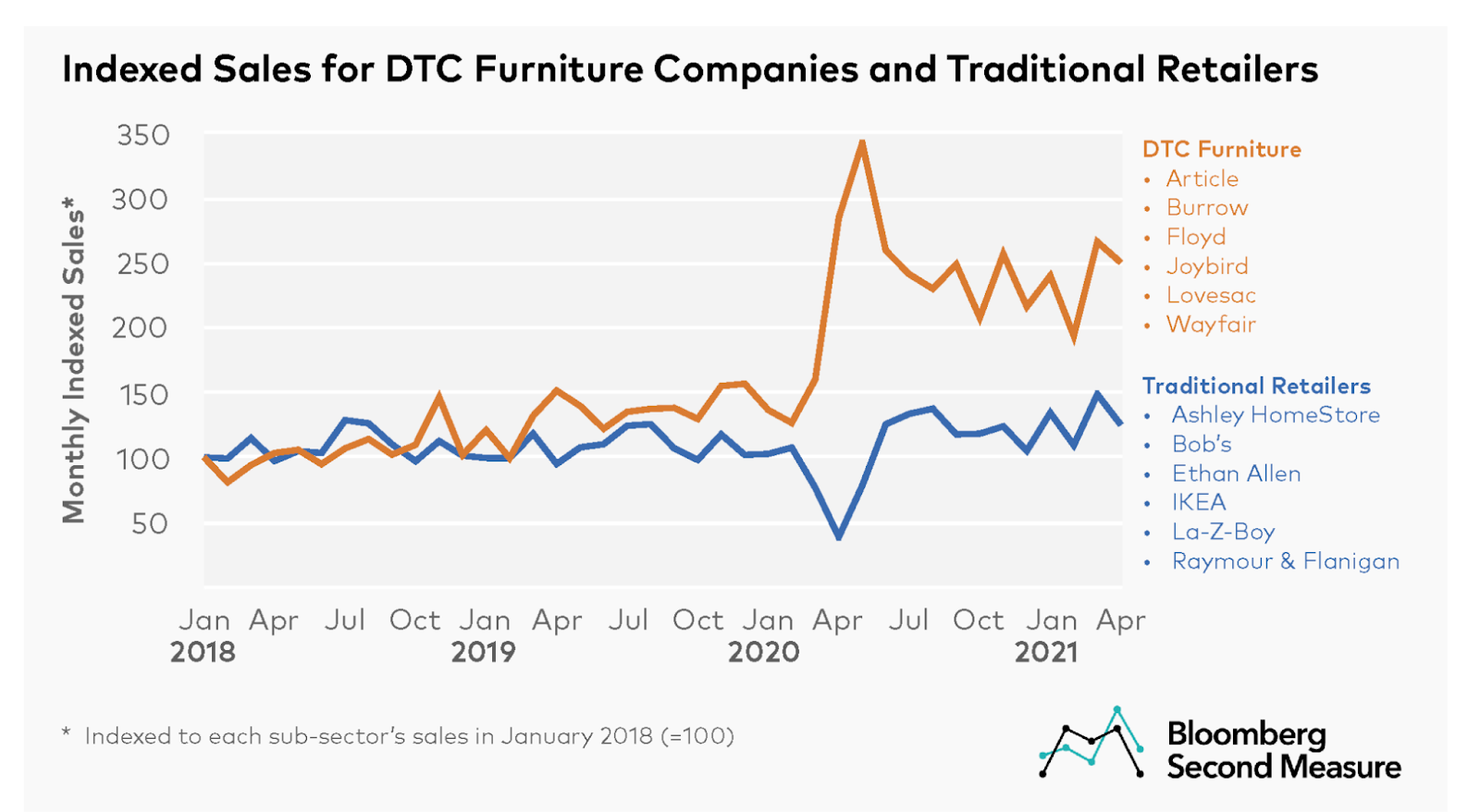
Apparently, D2C has growing potential across industries, including high-value products like furniture, and the ability to adapt effectively to changing market conditions. North America has the highest share of digitally-only D2C brands, generating 135 billion U.S. dollars in 2023.
The 2025 furniture eCommerce market size was estimated at nearly 257 billion U.S. dollars, underscoring the segment's potential. Thus, Direct-To-Consumer furniture brands should prioritize digital-first strategies to effectively capture this growing demand. Nielsen (2024) and Shopify (2025) highlighted some eCommerce furniture trends for brands to consider:
- Investing in immersive tech (e.g., augmented reality and 3D visualization)
- A preference for researching products digitally before visiting stores
- Rising demand for personalization to experience custom DTC furniture
- Delivery expectations for greater flexibility in dates, locations, and times
- Growing interest in second-hand and refurbished furniture
- Adopting omnichannel strategies to maximize ROI
- Evolving designs toward multifunctional, versatile, and modular furniture.
Why D2C Furniture Is Disrupting the Industry?
Direct-to-consumer furniture is transforming how brands operate in the modern retail market. Removing traditional intermediaries is an early reason to attain the benefits below:
- End-to-end Customer Experience Control
This business model enables D2C furniture brands to better control the entire customer journey. You manage your own eCommerce platforms, furniture marketing strategies, sales collaboration tools, and customer interactions. From that, you can gather valuable customer data, personalize experiences, and continuously improve your offerings to engage shoppers.
- Cost Efficiency & High Stakeholder Returns
Eliminating third-party and middle channels helps you reduce distribution costs. That’s why D2C businesses can either offer more competitive pricing or maintain higher profit margins. Furthermore, commercial flexibility and cost advantages increase shareholder value by enabling more accurate data ownership and streamlined operations across departments.
- Personalization & D2C Custom Furniture
Another major driver of the D2C model's success is the growing demand for product customization. More and more customers increasingly expect personalized products that match their preferences and real-world spaces. That’s when brands need to adopt D2C eCommerce solutions, such as 3D customizers, product configurators, AR solutions, and Visual CPQ, to offer interactive experiences. They let buyers configure D2C custom furniture directly and visualize it from all angles, even in their homes, before adding it to their carts.
- Sustainability
By optimizing supply chains and reducing unnecessary distribution layers, furniture brands can lower transportation emissions and minimize excess inventory. Additionally, many DTC businesses focus on automating manufacturing processes and removing paper handling, aligning with growing buyer demand for environmentally conscious products and brands.
4 Best Strategies for Direct-To-Consumer Furniture Brands
To stand out in the increasingly competitive market, direct-to-consumer furniture brands’ online strategies should go beyond simply publishing a store. Brands need to combine data-driven insights, immersive technologies, and efficient logistics for exceptional journeys.
#1. Clarify Your Customers’ Needs
Furniture brands need to analyze buying behaviours, lifestyle preferences, and common pain points in furniture shopping. Customer data, surveys, and analytics tools help identify expectations related to customization, delivery flexibility, pricing, and design preferences. This makes furniture brands tailor their offerings and marketing messages more effectively.
#2. Prioritize Niche Positioning
Rather than targeting the entire furniture market, successful brands often focus on a specific niche. This could include sustainable furniture, modular solutions, luxury custom designs, or office and public space furniture. Niche selection is essential for differentiating in crowded markets while building stronger brand identities and attracting highly targeted audiences. .
#3. Build A Web Store With Self-Serving Visual Configuration Tools and CPQ
Direct-to-consumer furniture brands are increasingly adopting 3D tools to drive conversions for their eCommerce stores and strengthen customer loyalty with immersive experiences.
This software offers both 3D product customization and 3D visualization for your furniture store. Buyers can configure desired items by selecting colors, materials, sizes, dimensions, modules, add-ons, and more, and then visualize the final designs before making purchases.
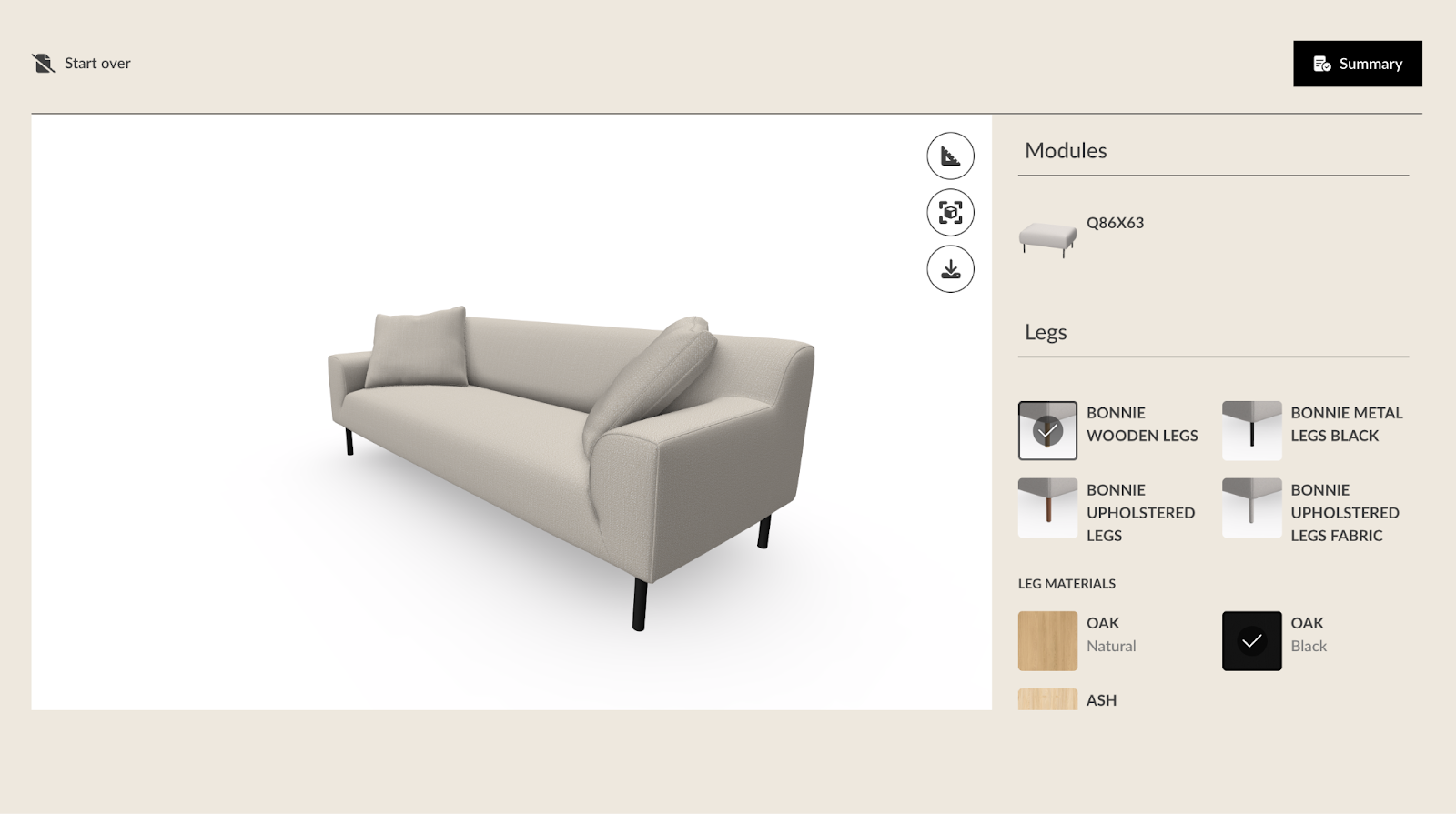
Instead of requesting manual quotes from sales teams, this technology allows customers to see accurate product pricing instantly based on their selected options. This helps reduce customer hesitation at checkout, effectively speeding up the DTC furniture buying journey.
To further enhance the customer experience, many furniture businesses integrate AR into D2C eCommerce software, such as 3D furniture configurators and Visual CPQ platforms. Shoppers can freely place custom furniture pieces directly into their real-world spaces (e.g., homes and offices) using mobile devices to better evaluate the fit with other decorations.
This application of using 3D models for furniture is to design entire rooms and bring them to life by adding realistic wall and floor materials. These planners ensure detailed floor plans and interior designs are displayed with accurate dimensions and various combinations. As a result, shoppers feel more confident about visualizing selected furniture in this environment.
#4. Lead The Best GEO Solutions
Many global brands are now inspired by the best GEO solutions for US direct-to-consumer furniture brands and are adapting them to other regional markets. AR VR solutions help customers visualize furniture online while maintaining immersive shopping experiences.
At the operational level, brands can enhance fulfillment through hyper-local logistics, white-glove delivery services, and regionalized inventory management to ensure smooth last-mile delivery for bulky furniture, shorten delivery times, and minimize shipping costs.
Meanwhile, investing in local SEO, a strong digital presence, and AI-driven in-market targeting enables furniture brands to reach customers more effectively and personalize campaigns.
Book a demo today to see 3D solutions transform your D2C furniture operations and sales.
Table of Content
-3.avif)
Streamline your process today!


